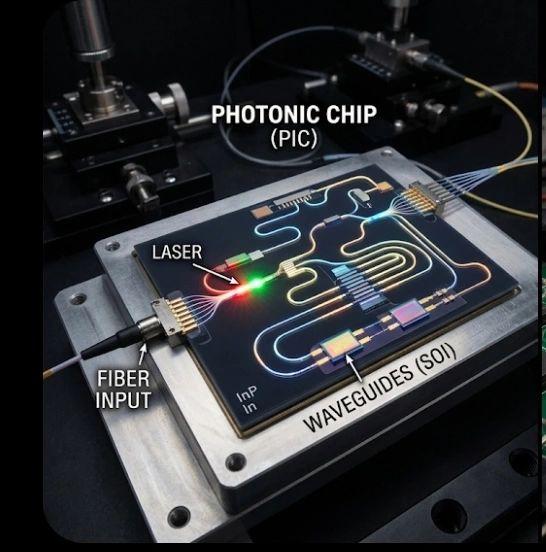
Introduction to Photonic Computing Breakthroughs
Photonic Computing Breakthroughs are opening new possibilities for faster and more energy-efficient computing by using light instead of relying entirely on electrical signals. As artificial intelligence, machine learning, and scientific simulations demand increasing computing power, researchers are exploring photonic chips that can process information using photons. These technologies could help reduce communication delays and improve computing performance, although practical challenges remain.
Traditional electronic processors use electrical signals to perform calculations and transfer information. Photonic computing uses optical signals, including the amplitude, phase, and wavelength of light, to carry out selected operations. Some photonic systems can process many optical signals in parallel, making them promising for particular AI workloads.
Research published in 2026 highlights advances in integrated photonic chips, optical neural networks, and nanophotonics. However, photonic computing is not expected to replace every electronic processor immediately. Accuracy, manufacturing complexity, energy consumed by supporting electronics, and the difficulty of integrating optical components remain important challenges.
Table of Contents
- Understanding Photonic Computing Breakthroughs
- Silicon Photonic Chips
- Photonic Computing Breakthroughs in Artificial Intelligence
- Optical Neural Networks
- Energy-Efficient Photonic Computing Breakthroughs
- Photonic Computing for Data Centers
- Future Applications of Photonic Computing Breakthroughs
- Hidden Risks and Technical Challenges
- The Future of Photonic Computing Breakthroughs
- Conclusion
1. Understanding Photonic Computing Breakthroughs
Photonic computing uses light to perform certain computational operations or transfer information between components. Instead of depending only on moving electrons through conventional circuits, these systems use optical components such as waveguides, modulators, lasers, and photodetectors.

A waveguide directs light along a defined path on a chip. A modulator changes an optical signal to represent information, while a photodetector converts light back into an electrical signal when needed. By combining these components, researchers can build systems that perform mathematical operations or move large amounts of data.
One major advantage is optical bandwidth. Different wavelengths of light can carry separate information channels through the same optical path. Photonic systems can also exploit interference and parallel processing to perform particular calculations efficiently.
Nevertheless, light-based computing has limitations. Many practical systems still require electronic circuits for memory, control, data preparation, and final calculations. The most useful approach may therefore combine photonic and electronic components rather than attempt to eliminate electronics completely.
2. Photonic Computing Breakthroughs in Silicon Photonic Chips
Silicon photonics is an important area of photonic computing research because it uses semiconductor manufacturing techniques to integrate optical components onto chips. Researchers can combine optical waveguides and other photonic structures with electronic technologies to create compact systems.
Recent research has explored improvements in optical modulators, light sources, photodetectors, and connections between chips. Better integration could help optical processors communicate with memory and other computing components more efficiently.
Silicon photonics is particularly relevant to data centers, where AI accelerators exchange large quantities of information. Moving data optically can offer advantages over electrical connections in certain applications, especially when bandwidth and communication distance become important.
However, silicon photonics does not automatically make every calculation faster. Designing reliable optical components, controlling temperature, reducing signal loss, and achieving high manufacturing yields remain significant engineering tasks.
The strongest near-term opportunity may be improving connections between processors and other hardware. More advanced optical computing systems could eventually perform a greater share of selected calculations directly in the optical domain.
3. Photonic Computing Breakthroughs in Artificial Intelligence
Artificial intelligence requires extensive mathematical calculations, particularly when training and running large neural networks. Photonic Computing Breakthroughs could help accelerate selected operations, such as matrix-vector multiplication, which appears frequently in machine learning.
Optical signals can be arranged so that their interactions represent mathematical relationships. By carefully designing optical circuits, researchers can perform certain calculations through light propagation and interference.
This approach could offer high throughput for workloads that can be mapped efficiently onto optical hardware. It may also reduce some data-transfer bottlenecks when photonic processing is integrated closely with electronic AI accelerators.
Researchers are investigating how optical processors can support image recognition, scientific computing, and other AI applications. Yet laboratory demonstrations do not necessarily translate into faster performance for every real-world model. Data movement, electronic conversion, memory access, and software compatibility all influence overall results.
Future progress will depend on testing complete systems rather than isolated optical components. Researchers must measure the total energy used, the accuracy of calculations, and the time needed to complete practical AI tasks.
4. Photonic Computing Breakthroughs in Optical Neural Networks
Optical neural networks use photonic components to implement selected operations inspired by artificial neural networks. These systems can use optical interference, wavelength multiplexing, and interconnected waveguides to process signals.
One promising direction is the development of programmable optical networks. Programmability allows a system to be configured for different tasks rather than being permanently limited to one calculation. Researchers are also exploring photonic spiking neural networks, which process short optical pulses to represent events or neural signals.

In March 2026, Optica reported research on photonic chips designed to support fast learning and decision-making in spiking neural systems. This work illustrates how photonic hardware may eventually support real-time processing in robotics and autonomous systems.
Despite these advances, building deeper and larger optical neural networks remains difficult. Optical signals can weaken as they travel, and small component variations may affect calculation accuracy. Nonlinear operations, which are essential for many neural networks, can also require additional hardware or electronic processing.
The future of optical neural networks will depend on improving accuracy, programmability, scalability, and integration with conventional computing systems.
5. Energy-Efficient Photonic Computing Breakthroughs
Energy consumption is one of the most important questions in modern computing. AI data centers need substantial electricity for processors, memory, networking, and cooling. Photonic computing may help reduce the energy required for certain calculations and optical data transfers.
Light can travel through suitable optical paths with relatively low transmission loss, and optical systems can process multiple channels in parallel. These properties create opportunities to improve throughput without increasing electrical switching activity in the same way as some conventional approaches.
However, the full energy cost must be considered. Lasers require power, optical signals may need amplification, and photodetectors and electronic circuits consume energy. Some systems also need frequent adjustments to maintain stable operation.
For this reason, a photonic chip that performs one operation efficiently may not necessarily make an entire computer more energy-efficient. Researchers must compare complete workloads, including signal conversion, memory access, control circuitry, and cooling.
The main opportunity is to use photonic components where they provide a measurable advantage. Hybrid systems could combine optical processing with electronic memory and control to balance speed, accuracy, and energy use.
6. Photonic Computing Breakthroughs for Data Centers
Data centers increasingly depend on fast communication between processors, accelerators, memory, and networking equipment. As AI workloads grow, electrical connections can face challenges involving power consumption, signal integrity, bandwidth, and heat.
Optical interconnects use light to carry data between components. Silicon photonics can help integrate these optical connections into compact hardware, potentially increasing bandwidth while reducing some communication costs.
One development area is co-packaged optics, where optical components are integrated close to computing chips. Shorter electrical connections can help address certain signal and power challenges, although thermal design and manufacturing complexity must be managed carefully.
Photonic computing may eventually go beyond communication to accelerate selected calculations within data-center hardware. For now, optical communication and optical computation should be understood as related but distinct technologies. A chip that transfers data with light is not necessarily performing its calculations with light.
As these systems mature, real-world testing will determine which designs offer the best balance of cost, reliability, power consumption, and performance.
7. Future Applications of Photonic Computing Breakthroughs
Photonic computing research could influence several areas beyond conventional AI processors. Scientific computing may benefit from optical systems designed to perform selected mathematical operations at high throughput. Image processing and signal analysis are also potential applications because they often involve repetitive calculations that can be mapped onto specialized hardware.
In robotics, photonic neural systems may help process sensor information and support rapid decisions. Researchers are investigating whether optical processing can contribute to systems that need low latency, although practical deployment will require dependable hardware and software integration.
Another potential area is edge computing, where devices process data close to where it is collected. Compact photonic components could eventually support specialized processing in communication equipment, sensors, or other systems where speed and power efficiency matter.
Photonic computing is also connected to quantum photonics, which uses quantum states of light for quantum information processing. Quantum photonic computing is different from classical photonic computing and faces its own challenges, including photon loss and the difficulty of building reliable, scalable systems.
These applications remain at different stages of development. Their future success will depend on the requirements of each task and evidence from complete working systems.
8. Photonic Computing Breakthroughs: Hidden Risks and Challenges
Despite the potential benefits, Photonic Computing Breakthroughs face several obstacles. The first is computational accuracy. Some photonic processors perform analog operations, which can be affected by noise, optical loss, component imperfections, and variations in temperature.
The second challenge is integration. Computers require memory, control logic, software, and many other components. Converting information between electrical and optical formats can add latency and consume energy, potentially reducing the advantages of optical processing.
Manufacturing is another concern. Photonic systems may require precise alignment, specialized materials, lasers, and sophisticated packaging. Scaling these systems to high production volumes while maintaining reliability and controlling costs is difficult.
Software compatibility also matters. Existing applications are generally designed for electronic processors, so developers may need specialized tools to map calculations onto photonic hardware. Not every workload is suitable for optical processing.
Finally, performance claims must be evaluated carefully. A demonstration showing exceptional speed for one mathematical operation does not establish that an entire computer will outperform conventional hardware. Fair comparisons should consider accuracy, total energy consumption, data transfer, and the cost of supporting equipment.
9. The Future of Photonic Computing Breakthroughs
The next phase of Photonic Computing Breakthroughs will likely focus on practical integration rather than speed alone. Researchers are working to improve optical component density, programmable architectures, precision, manufacturing reliability, and connections between photonic and electronic circuits.
Advances in nanophotonics may help control light at very small scales, while improved fabrication could make complex optical chips easier to manufacture. Researchers are also exploring new approaches to scaling optical neural networks without allowing signal loss and calculation errors to grow excessively.
Artificial intelligence could help engineers design and optimize photonic circuits, but those designs still need experimental validation. Future progress will also depend on standards, software tools, reliable packaging, and the availability of applications that benefit from optical processing.
In the near term, photonics is likely to have its clearest impact in optical communications and specialized computing tasks. Broader use in general-purpose computing will require substantial engineering progress and convincing real-world results.
10. Conclusion: Photonic Computing Breakthroughs Bring Hope and Risks
Photonic Computing Breakthroughs offer a promising way to improve selected computing operations and move data more efficiently using light. Silicon photonics, optical neural networks, AI acceleration, and advanced optical interconnects are important areas of ongoing research.
However, photonic computing is not a universal replacement for electronic processors. Accuracy, energy use across the full system, manufacturing cost, memory access, and integration remain significant challenges.
The most realistic future may involve hybrid computers that combine the strengths of light and electronics. As researchers continue testing new designs, practical measurements and independent validation will reveal which applications can deliver meaningful benefits.
Leave a Reply