Introduction to Enhanced Geothermal Energy Research
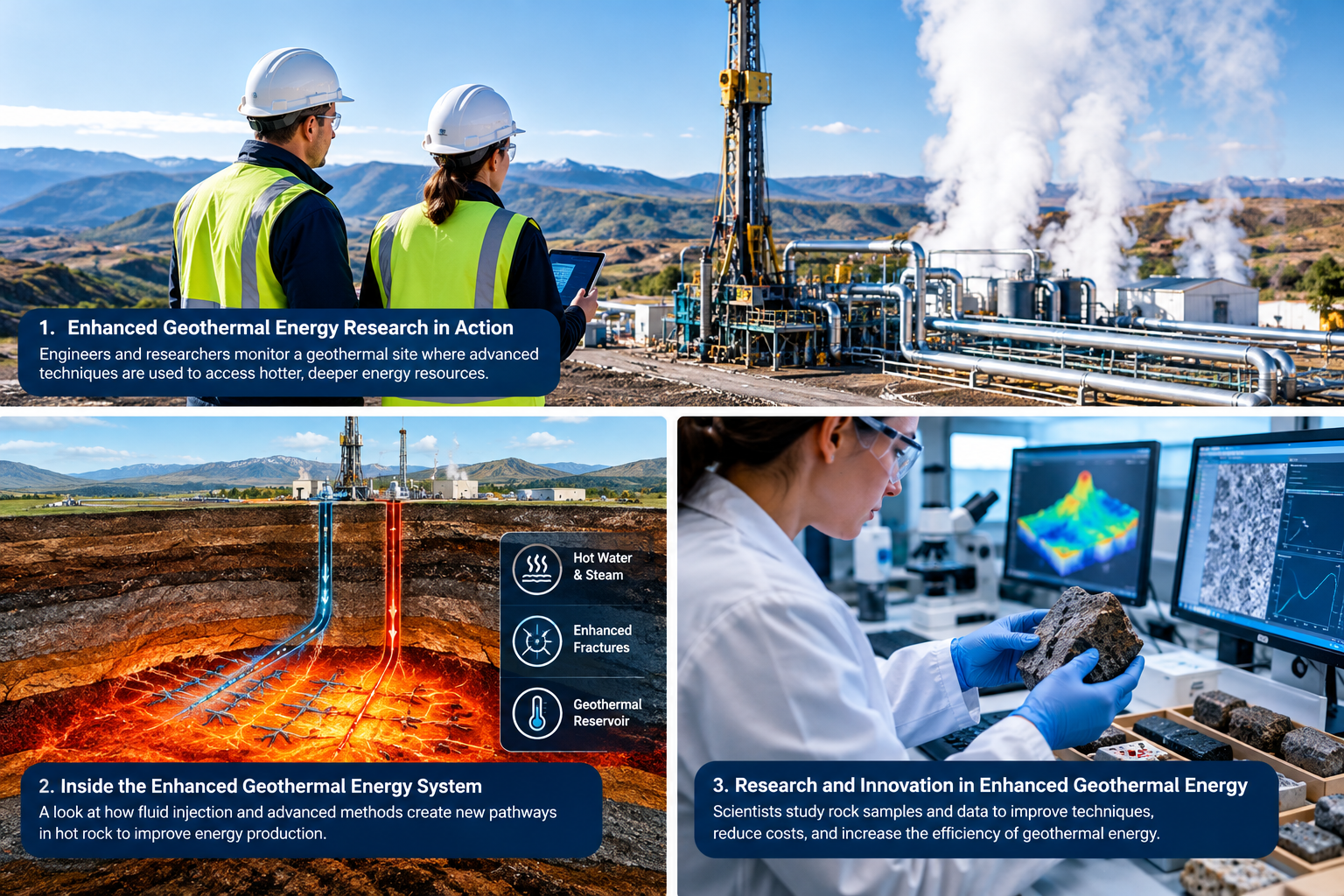
Enhanced Geothermal Energy Research is opening new possibilities for producing reliable, low-carbon electricity from the heat stored deep beneath the Earth’s surface. As countries search for cleaner energy sources, enhanced geothermal systems (EGS) are attracting attention because they may allow electricity generation in locations where conventional geothermal resources are limited. Recent research focuses on advanced drilling, improved underground reservoirs, superhot rocks, and smarter monitoring technologies.
Unlike solar and wind power, which depend on weather conditions, geothermal power can potentially provide electricity around the clock. However, drilling costs, underground uncertainty, water management, and earthquake risks remain important challenges. Understanding these benefits and limitations helps readers evaluate the real potential of this emerging technology. The U.S. Department of Energy identifies improved drilling, reservoir engineering, and cost reduction as important areas for developing enhanced geothermal systems. <Cite refs={[“turn650495search0″,”turn650495search4”]}/>
What Is Enhanced Geothermal Energy Research?
Enhanced Geothermal Energy Research investigates ways to access underground heat in locations where hot rocks do not naturally contain enough connected cracks or circulating fluid to support conventional geothermal production.
An enhanced geothermal system typically uses wells to reach hot underground rock. Carefully managed fluid injection creates or reopens fractures, allowing water to circulate through the heated rock. The heated fluid returns to the surface, where its thermal energy can generate electricity or provide useful heat.
Yeh rahe aap ke article “Introduction to Enhanced Geothermal Energy Research” ke liye 3 related picks:

Researchers also investigate closed-loop geothermal systems, which circulate fluid through sealed underground pipes, and superhot geothermal resources, which aim to access much higher temperatures. These approaches are related but technically different, and their commercial readiness varies. <Cite refs={[“turn650495search0″,”turn650495search5”]}/>
Seven Powerful Enhanced Geothermal Energy Research Breakthroughs
1. Advanced Drilling in Enhanced Geothermal Energy Research
Drilling deep into extremely hot, hard rock is one of geothermal energy’s biggest technical and financial challenges. Researchers are improving drilling equipment, well construction, casing materials, and methods for evaluating well performance.
Better drilling technology could help projects reach deeper resources more efficiently and reduce the expense of constructing wells. This matters because well construction represents a substantial portion of enhanced geothermal project costs. More durable materials are also important because high temperatures and demanding underground conditions can damage equipment over time. <Cite refs={[“turn650495search0″,”turn650495search11”]}/>
2. Artificial Reservoirs in Enhanced Geothermal Energy Research
Some underground formations contain considerable heat but lack the natural permeability required for efficient energy extraction. Enhanced geothermal systems address this problem by creating or reopening pathways through which fluid can move.

Researchers study rock properties, fracture patterns, fluid pressure, and reservoir behavior to improve heat extraction. The objective is to establish reliable circulation without causing excessive fluid loss or compromising reservoir performance. Successful reservoir engineering could make geothermal development possible in a wider range of geological settings. <Cite refs={[“turn650495search0″,”turn650495search6”]}/>
3. Superhot Rock in Enhanced Geothermal Energy Research
Superhot geothermal research explores resources at exceptionally high temperatures. The U.S. Department of Energy describes superhot systems as targeting temperatures above 375°C. Water exposed to these conditions can carry substantial thermal energy, potentially increasing the power generated from a geothermal well.
However, reaching these environments requires equipment capable of operating under extreme temperatures and pressures. Scientists must also understand how rock fractures, fluids, and well materials behave in these conditions. Superhot geothermal power remains a developing field rather than a universally proven commercial solution. <Cite refs={[“turn650495search0″,”turn650495search5”]}/>
4. Artificial Intelligence in Enhanced Geothermal Energy Research
Artificial intelligence and machine learning may help researchers analyze geological surveys, drilling records, temperature measurements, and underground pressure data. These tools can identify patterns that are difficult to detect using conventional analysis alone.
Improved predictions could help teams select promising drilling locations, estimate reservoir performance, and recognize possible equipment problems earlier. Digital models can also support decisions about fluid injection and heat extraction. Nevertheless, AI predictions depend on data quality and require validation against real-world measurements before they can be trusted for critical operational decisions. <Cite refs={[“turn650495search6″,”turn650495search12”]}/>
5. Real-Time Monitoring in Enhanced Geothermal Energy Research
Modern monitoring systems help engineers observe underground conditions during drilling and energy production. Sensors can track pressure, temperature, fluid flow, and seismic activity, providing information about changes within a geothermal reservoir.
This information can support adjustments to injection rates and operating procedures. Monitoring is especially important because underground stimulation can sometimes trigger small earthquakes. Combining sensor data with geological models may help operators identify warning signals and respond more quickly when conditions change. <Cite refs={[“turn650495search0″,”turn650495search21”]}/>
6. Closed-Loop Technology in Enhanced Geothermal Energy Research
Closed-loop geothermal systems circulate fluid through sealed pipes placed underground. Unlike conventional enhanced geothermal systems, they do not depend on circulating fluid through a deliberately stimulated network of rock fractures.
This design may reduce some concerns associated with fluid loss into the surrounding formation. It could also expand geothermal options in certain geological settings. However, heat transfer, drilling expense, pipe durability, and system efficiency still determine whether a project can operate economically. Closed-loop technology is an important related development, but its performance should not be assumed to match that of every enhanced geothermal system. <Cite refs={[“turn650495search0″,”turn650495search6”]}/>
7. Better Heat Extraction in Enhanced Geothermal Energy Research
A geothermal reservoir must deliver heat reliably over many years to justify the expense of drilling and construction. Researchers are investigating ways to improve fluid circulation, control fracture permeability, and reduce uneven heat distribution.
One challenge is thermal short-circuiting, which can occur when injected fluid returns too quickly through a limited pathway before extracting enough heat from the surrounding rock. Research into reservoir modeling and fracture management aims to improve heat recovery and system longevity. If these approaches succeed, geothermal facilities could produce more useful energy from their underground resources. <Cite refs={[“turn650495search0″,”turn650495search12”]}/>
Major Benefits of Enhanced Geothermal Energy Research
Reliable Electricity Through Enhanced Geothermal Energy Research
One major advantage of geothermal power is its potential to provide continuous electricity regardless of sunshine or wind conditions. This reliability could complement variable renewable sources and help electricity systems meet demand when solar and wind generation falls.
Actual output still depends on the resource, equipment, maintenance, and reservoir performance. Even so, successfully developed geothermal facilities can offer a useful source of dependable low-carbon power.
Lower Emissions Through Enhanced Geothermal Energy Research
Geothermal electricity generally has low operational greenhouse gas emissions compared with fossil-fuel power generation. It can therefore contribute to electricity-sector decarbonization, although emissions vary by site and system design.
Construction, drilling, pumping, and some underground gases can contribute to a project’s environmental footprint. Careful design and monitoring are necessary to maximize the climate benefits.
Wider Energy Access Through Enhanced Geothermal Energy Research
Conventional geothermal power often depends on favorable natural geological conditions. Enhanced systems may extend geothermal development to additional locations by engineering fluid pathways in hot rock.
This could diversify energy supplies and reduce dependence on a single generation technology. Nevertheless, local geology, drilling costs, permitting, and access to transmission infrastructure still determine which locations are practical.
Potential Economic Growth Through Enhanced Geothermal Energy Research
Geothermal projects can create work in drilling, engineering, construction, equipment manufacturing, maintenance, and scientific research. Existing expertise from the oil and gas sector may also be adapted to geothermal development.
Long-term economic benefits depend on project costs, financing, electricity prices, and successful operation. Research that improves drilling speed and reduces equipment failures could help strengthen the business case for new projects. <Cite refs={[“turn650495search3″,”turn650495search7”]}/>
Five Hidden Risks of Enhanced Geothermal Energy Research
1. High Initial Costs in Enhanced Geothermal Energy Research
Deep drilling and specialized equipment require substantial upfront investment. If a well fails to encounter suitable rock conditions or a reservoir performs poorly, developers may lose significant amounts of money before electricity production begins.
Improved geological surveys and drilling methods can reduce uncertainty, but they cannot eliminate it completely.
2. Earthquake Risks in Enhanced Geothermal Energy Research
Injecting fluid underground and changing pressure along existing faults can trigger induced seismicity. Many events associated with industrial operations are small, but some geothermal projects have experienced earthquakes significant enough to disrupt communities or operations.
Risk management includes detailed geological assessment, continuous seismic monitoring, controlled injection, and clear procedures for reducing or stopping operations when necessary. <Cite refs={[“turn650495search0″,”turn650495search6”]}/>
3. Water Management in Enhanced Geothermal Energy Research
Some geothermal systems require water or other working fluids to circulate through underground wells. Water availability, fluid leakage, mineral deposits, and chemical interactions can affect project performance and environmental safety.
Recycling fluids and designing suitable water-management systems may reduce these problems. Each site still needs an assessment of local water resources and groundwater protection requirements.
4. Equipment Damage in Enhanced Geothermal Energy Research
Extreme temperatures, pressure, corrosion, and mineral deposits can reduce the lifespan of wells, pumps, sensors, and pipes. Equipment failures can cause expensive repairs and interrupt electricity production.
Advanced materials and regular inspections can improve reliability, but geothermal developers must account for maintenance and replacement costs over the entire project lifecycle.
5. Geological Uncertainty in Enhanced Geothermal Energy Research
Underground formations cannot be observed completely from the surface. Rock permeability, fault structures, stress conditions, and heat distribution may differ from initial estimates.
Unexpected conditions can lower production, increase drilling requirements, or create additional safety concerns. Detailed exploration and updated geological models are therefore essential before a project expands to commercial scale.
Enhanced Geothermal Energy Research Comparison Table
The following table compares selected geothermal approaches. It is a qualitative overview, not a measured performance ranking.
| Technology | Main advantage | Main challenge |
|---|---|---|
| Conventional geothermal | Established technology in suitable locations | Requires favorable natural resources |
| Enhanced geothermal systems | May access hot rock with limited natural permeability | Reservoir stimulation and induced seismicity |
| Closed-loop geothermal | Circulates fluid through sealed pipes | Heat-transfer and drilling costs |
| Superhot geothermal | Potentially extracts more heat per unit of fluid | Extreme temperature and material challenges |
These technologies differ in their designs, resource requirements, and stages of development. Project-specific engineering and economic analysis are needed to determine the most appropriate approach. <Cite refs={[“turn650495search0″,”turn650495search5″,”turn650495search6”]}/>
Enhanced Geothermal Energy Research Graph
The following conceptual chart illustrates how a geothermal project might balance potential benefits against implementation challenges. These scores are illustrative editorial ratings from 1 to 5, not official research measurements or predictions for a real project.
| Factor | Illustrative score |
|---|---|
| Reliable power potential | 5/5 |
| Low-carbon energy potential | 4/5 |
| Potential for wider geographic access | 4/5 |
| Upfront cost challenge | 5/5 |
| Need for seismic monitoring | 4/5 |
Text graph — illustrative scores
Reliable power potential █████ 5/5
Low-carbon potential ████░ 4/5
Wider access potential ████░ 4/5
Upfront cost challenge █████ 5/5
Seismic monitoring need ████░ 4/5
The chart highlights an important distinction: the technology’s potential benefits can be substantial, but high initial costs and the need for careful monitoring remain serious considerations. The scores are not directly comparable scientific measurements.
The Future of Enhanced Geothermal Energy Research
The future of enhanced geothermal energy will depend on whether research can make projects safer, more predictable, and less expensive. Continued improvements in drilling, well construction, reservoir characterization, high-temperature equipment, and monitoring could help the technology reach more locations.
Demonstration projects are particularly important because they test whether laboratory findings and engineering models translate into reliable performance underground. Research teams must measure not only electricity production but also water use, induced seismicity, equipment life, and total project cost.
The U.S. Department of Energy has previously set a goal of reducing enhanced geothermal system costs to $45 per megawatt-hour by 2035. This is a historical program target, not a guarantee of future prices or a claim that all projects have achieved that cost. <Cite refs={[“turn650495search2″,”turn650495search1”]}/>
For communities and energy developers, the most promising path is careful expansion based on transparent data, responsible site selection, and ongoing environmental monitoring. Enhanced geothermal energy could become an important part of a cleaner electricity system, but its ultimate contribution will depend on proven technical and economic results.
Frequently Asked Questions About Enhanced Geothermal Energy Research
What is enhanced geothermal energy research?
Enhanced Geothermal Energy Research studies methods for extracting underground heat where natural fluid circulation or rock permeability is insufficient for conventional geothermal production.
What are the main benefits of enhanced geothermal energy?
Its main potential benefits include dependable electricity, low operational carbon emissions, wider access to geothermal resources, and opportunities for skilled employment.
What are the biggest risks of enhanced geothermal energy?
The main risks include high upfront costs, induced seismicity, water-management challenges, equipment damage, and uncertainty about underground geological conditions.
Is enhanced geothermal energy renewable?
Geothermal energy is generally considered renewable when underground heat is managed sustainably and extraction does not exceed the resource’s ability to support long-term production. Performance depends on site conditions and reservoir management.
Can enhanced geothermal energy work anywhere?
No. Enhanced geothermal systems could expand the range of usable locations, but suitable temperatures, geology, drilling access, project economics, and infrastructure are still required.
How does artificial intelligence help geothermal research?
AI can help analyze geological and operational data, improve predictions, support drilling decisions, and detect unusual changes. Its findings need validation using reliable measurements.
Is enhanced geothermal energy commercially proven?
Geothermal electricity is commercially established, and some enhanced geothermal projects have demonstrated important capabilities. However, widespread commercial deployment of next-generation systems still depends on improving costs, reliability, and risk management.
Conclusion: Why Enhanced Geothermal Energy Research Matters
Enhanced Geothermal Energy Research offers a promising route to dependable, lower-carbon energy. Advances in drilling, artificial reservoirs, superhot rock, artificial intelligence, monitoring, and heat extraction could make underground heat accessible in more places.
However, the technology is not risk-free. Expensive drilling, induced earthquakes, water management, equipment durability, and geological uncertainty must be addressed before every project can be considered economically viable.
The strongest path forward combines continued innovation with transparent monitoring and realistic cost assessments. If researchers and developers can demonstrate safe, reliable, and affordable performance, enhanced geothermal energy could play a valuable role in the future energy mix.