Introduction to Self-Driving Laboratory Breakthroughs
Self-Driving Laboratory Breakthroughs are changing how scientists discover new materials, develop chemical reactions, test medicines, and investigate complex scientific problems. These advanced laboratories combine artificial intelligence (AI), robotics, automated equipment, and data analysis to design and perform experiments with less manual intervention. Instead of relying entirely on researchers to choose every experiment, an intelligent system can analyze previous results and recommend the next experiment.
The goal is not simply to make laboratories work without people. It is to help scientists investigate more possibilities, reduce repetitive work, and learn from experimental results more efficiently. Recent research highlights the growing role of autonomous laboratories in chemistry, materials science, and other research fields. However, their reliability, safety, cost, and ability to work across different laboratories remain important challenges.
Table of Contents
- What Self-Driving Laboratory Breakthroughs Mean
- How Self-Driving Laboratory Breakthroughs Work
- Eight Powerful Self-Driving Laboratory Breakthroughs
- Benefits of Self-Driving Laboratory Breakthroughs
- Risks of Self-Driving Laboratory Breakthroughs
- Comparison Table
- Future of Self-Driving Laboratory Breakthroughs
- Frequently Asked Questions
- Conclusion
What Are Self-Driving Laboratory Breakthroughs?
Self-Driving Laboratory Breakthroughs involve laboratory systems that combine software with physical equipment to carry out scientific experiments. Depending on their design, these systems can suggest experimental conditions, prepare samples, operate instruments, collect measurements, and use the results to select further tests.
A conventional laboratory often follows a process in which a researcher plans an experiment, performs it, studies the result, and decides what to do next. An autonomous laboratory can connect many of these stages through an automated feedback loop.

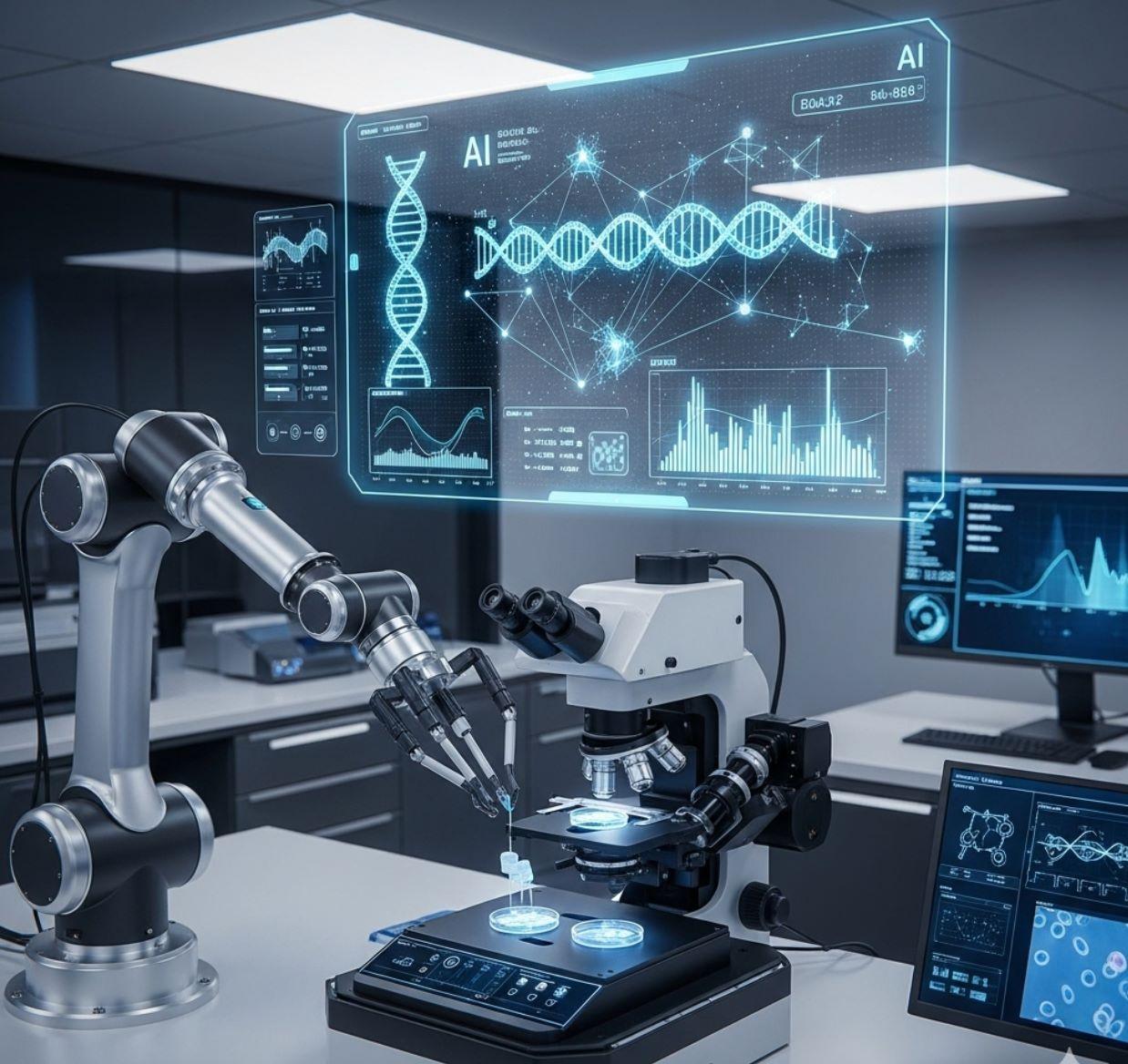
Featured image: AI-powered autonomous laboratory
This approach is especially useful when researchers need to examine thousands of possible combinations. Scientists still define research goals, evaluate evidence, and make important decisions, but automation can handle many repetitive tasks.
How Self-Driving Laboratory Breakthroughs Work
Most self-driving laboratories follow a cycle of prediction, experimentation, measurement, and improvement. First, a scientist defines a goal, such as finding a more efficient catalyst or identifying a material with a particular property. An AI model then helps select promising experimental conditions.
Robotic instruments or automated equipment carry out the selected experiment. Sensors and analytical tools measure the results, and the software compares those results with its predictions. The system uses the new information to recommend the next experiment.
This repeated process is often called closed-loop experimentation. Its effectiveness depends on the quality of the data, the accuracy of the measurements, and how well the AI model understands uncertainty. Not every laboratory is fully autonomous; some still require people to prepare samples, approve decisions, or intervene when equipment encounters problems.
Eight Powerful Self-Driving Laboratory Breakthroughs
1. Self-Driving Laboratory Breakthroughs in Materials Discovery
Materials discovery is one of the most promising applications of autonomous experimentation. Researchers may want to develop stronger materials, better battery components, improved semiconductors, or substances that perform well under extreme conditions.

Inside the lab: Robotic experiment automation
Testing every possible combination manually can require substantial time and resources. AI can narrow the search by identifying promising candidates, while robotic equipment prepares and tests selected samples. Experimental results then help improve later predictions.
This method does not guarantee that a useful material will be discovered immediately. Its value is that researchers can explore a complicated search space more systematically and focus their attention on experiments likely to provide useful information.
2. Self-Driving Laboratory Breakthroughs in Chemical Reactions
Chemical reactions can depend on temperature, pressure, concentration, reaction time, and many other variables. A small change in one condition can produce a different outcome, making chemical optimization difficult.
Autonomous chemistry platforms can test selected combinations and measure the resulting products. Machine-learning methods can then identify patterns and recommend new conditions. This can help researchers investigate reaction efficiency, selectivity, and product quality.
Such systems are useful for exploring complex reaction spaces, but their success depends on suitable analytical equipment and reliable measurements. Chemical experiments also need appropriate safety controls, particularly when reactions involve heat, pressure, or hazardous substances.
3. Self-Driving Laboratory Breakthroughs in Battery Research
Battery research requires scientists to balance several competing properties, including energy storage, charging performance, lifetime, cost, and safety. Researchers must evaluate materials and manufacturing conditions to understand how these properties change.
Self-driving laboratory systems can assist by preparing samples, measuring electrochemical performance, and comparing results. AI can use the collected data to suggest which material combinations or experimental conditions deserve further investigation.
This approach could support research into improved battery materials and energy storage technologies. However, a promising result from a small laboratory sample does not automatically mean a battery will be affordable, durable, or safe when manufactured at commercial scale.
4. Self-Driving Laboratory Breakthroughs in Drug Research
Drug discovery involves identifying compounds that may interact with a biological target and then evaluating their properties. Automated laboratories can help researchers screen compounds, prepare samples, and collect experimental measurements.
AI can prioritize which candidates should be tested first, while robotic equipment helps process experiments consistently. This can reduce some repetitive laboratory work and help scientists organize large datasets.
Nevertheless, a compound that performs well in an early experiment is not necessarily an effective or safe medicine. Drug development still requires extensive biological testing, toxicology studies, clinical trials where appropriate, and regulatory review. Self-driving laboratories are research tools, not replacements for these essential steps.
5. Self-Driving Laboratory Breakthroughs in Clean Energy
Clean energy research includes catalysts, solar materials, hydrogen-related chemistry, and processes that could reduce industrial emissions. Many of these areas require the testing of numerous materials and operating conditions.
An autonomous laboratory can help compare alternatives, identify promising candidates, and learn from unsuccessful experiments. Researchers may use these systems to study catalysts that improve chemical efficiency or materials that could support next-generation solar technologies.
The long-term potential is significant because better materials and processes may contribute to more efficient energy systems. Yet laboratory performance must be followed by durability testing, environmental assessment, and evaluation under real operating conditions before practical benefits can be confirmed.
6. Self-Driving Laboratory Breakthroughs Through Robotic Automation
Robotics gives autonomous laboratories the physical ability to carry out tasks. Depending on the equipment, robots can move samples, dispense liquids, position instruments, or transfer materials between experimental stages.
Automation can improve consistency when repetitive tasks are performed correctly. It can also help laboratories operate outside normal working hours when the equipment and experiments are designed for safe, unattended operation.
However, robotic systems can make mistakes. A sample may be misplaced, a liquid may be dispensed incorrectly, or a mechanical component may fail. Reliable operation therefore requires calibration, monitoring, maintenance, and procedures for stopping experiments when something goes wrong.
7. Self-Driving Laboratory Breakthroughs in AI Experiment Planning
AI-driven experiment planning helps a laboratory decide which test should happen next. Rather than simply running a fixed list of experiments, the software can use earlier results to choose conditions that may improve performance or reduce uncertainty.
Some systems use methods such as Bayesian optimization to balance two goals: testing promising candidates and exploring areas where the model is uncertain. This can be valuable when experiments are expensive or when only a limited number of tests can be performed.
The quality of these decisions depends on the model and the information available to it. Poor data, unexpected experimental conditions, or assumptions that do not fit the real system can lead to misleading recommendations. Human review remains important when results affect safety or major research decisions.
8. Self-Driving Laboratory Breakthroughs in Connected Research Networks
A newer direction is to connect different autonomous laboratories so they can share compatible data, methods, and research capabilities. Instead of one laboratory handling every stage, specialized facilities could contribute different instruments or expertise to a wider research project.
Research initiatives are exploring how AI agents, robotics, and intelligent instruments could coordinate complex experiments across facilities. Such collaboration could help researchers tackle projects that are too demanding for a single laboratory.
The main challenge is interoperability. Different laboratories may use different instruments, data formats, sample preparation methods, and measurement standards. For a connected network to produce trustworthy results, researchers need clear documentation, compatible systems, and ways to verify that findings can be reproduced.
Benefits of Self-Driving Laboratory Breakthroughs
The major benefit of autonomous experimentation is that it can reduce the manual effort required to perform repetitive tests. Researchers may be able to investigate more experimental conditions and obtain useful measurements more consistently.
These systems can also support better use of laboratory resources. Carefully selected experiments may reduce unnecessary testing, material consumption, and waste. Automated records can make it easier to trace which conditions produced a particular result.
Another advantage is continuous learning. Each completed experiment can provide information that improves the next decision. This is particularly useful when scientists are studying complex systems in which many variables interact.
However, these benefits are not automatic. They depend on how the laboratory is designed, what it measures, and whether its performance is compared fairly with conventional methods.
Risks of Self-Driving Laboratory Breakthroughs
Despite their potential, autonomous laboratories introduce technical and operational risks. AI systems can recommend unsuitable experiments if their training data are incomplete or if the real experiment behaves differently from the model’s predictions.
Physical safety is another concern. Chemical spills, equipment failures, unexpected reactions, and robotic movement can create hazards. Laboratories need emergency stops, appropriate containment, monitoring, and human oversight based on the risks of each experiment.
Cost and accessibility also matter. Advanced robotic equipment, specialized software, maintenance, and skilled staff can be expensive. Smaller research institutions may struggle to build their own platforms, although shared facilities and remote laboratory services could help broaden access.
Finally, reproducibility and data quality remain essential. A result is more valuable when researchers can understand how it was produced, inspect the experimental records, and independently verify the findings.
Comparison Table: Self-Driving Laboratory Breakthroughs
| Research area | Main application | Potential benefit | Important limitation |
|---|---|---|---|
| Materials discovery | Testing new materials | Faster exploration | Results need validation |
| Chemical reactions | Optimizing conditions | More systematic testing | Reaction safety |
| Battery research | Comparing materials | Better candidate selection | Long-term performance |
| Drug research | Screening compounds | More efficient early research | Clinical validation |
| Clean energy | Studying catalysts and solar materials | Potential efficiency gains | Real-world durability |
| Robotic automation | Handling samples and equipment | Consistent repetitive tasks | Mechanical failures |
| AI experiment planning | Choosing the next test | More informative experiments | Model uncertainty |
| Connected laboratories | Sharing research workflows | Wider collaboration | Data compatibility |
Graph: Main Areas of Self-Driving Laboratory Research
The following is a conceptual illustration of research applications, not measured statistics or a ranking of their real-world impact.
<pre> Materials discovery ██████████ Chemical reactions █████████ Battery research ████████ Drug research ████████ Clean energy ████████ Robotic automation █████████ AI experiment planning ██████████ Connected laboratories ███████ </pre>
The bars simply highlight areas discussed in this article. They do not represent publication counts, success rates, funding, or verified performance data.
Future of Self-Driving Laboratory Breakthroughs
The future of Self-Driving Laboratory Breakthroughs will likely depend on systems becoming more reliable, easier to connect, and more accessible to researchers. Better robotics may allow laboratories to handle a wider range of samples, while improved AI models may help scientists choose experiments more effectively.
Researchers are also working toward stronger safety practices, better measurement standards, and more complete records of how experiments are performed. These improvements are important because a laboratory should not merely produce results quickly; it should produce results that can be checked and trusted.
In the longer term, connected research facilities could share capabilities and help teams work across scientific disciplines. Progress will still require human expertise, independent validation, suitable funding, and responsible oversight. The most useful laboratories will be those that combine automation with scientific judgment rather than treating AI predictions as unquestionable answers.
Frequently Asked Questions About Self-Driving Laboratory Breakthroughs
What are Self-Driving Laboratory Breakthroughs?
They are advances in laboratories that use AI, robotics, automated equipment, and feedback from experiments to improve scientific research with less manual intervention.
Can a self-driving laboratory replace scientists?
No. These systems can automate selected tasks and assist with experiment planning, but scientists are still needed to define research goals, validate results, manage safety, and interpret findings.
Which fields benefit from self-driving laboratories?
Chemistry, materials science, battery research, clean energy, and some areas of drug discovery are important application areas.
Are self-driving laboratories completely autonomous?
Not always. Some systems automate only certain stages, while more integrated platforms can select, run, measure, and refine experiments in a closed loop. Human supervision may still be necessary.
What is the biggest risk of self-driving laboratories?
There is no single risk for every system. Important concerns include unsafe experimental decisions, unreliable data, equipment failure, limited reproducibility, high costs, and insufficient human oversight.
Conclusion: The Promise of Self-Driving Laboratory Breakthroughs
Self-Driving Laboratory Breakthroughs offer a powerful approach to scientific experimentation by combining AI, robotics, automated measurement, and continuous feedback. Their applications range from discovering materials and optimizing chemical reactions to supporting battery, drug, and clean energy research.
The technology may help scientists investigate more possibilities and reduce repetitive work, but speed alone is not enough. Reliable data, strong safety measures, reproducible methods, and human judgment remain essential. With careful development, self-driving laboratories could become valuable partners in scientific discovery while keeping accountability and verification at the center of research.
Leave a Reply