Table of Contents
- Introduction to Sodium-Ion Battery Breakthroughs
- How Sodium-Ion Battery Breakthroughs Work
- 7 Major Sodium-Ion Battery Breakthroughs
- Benefits of Sodium-Ion Battery Breakthroughs
- Hidden Risks of Sodium-Ion Battery Breakthroughs
- Sodium-Ion Battery Breakthroughs vs. Lithium-Ion Batteries
- Future of Sodium-Ion Battery Breakthroughs
- Conclusion
Introduction to Sodium-Ion Battery Breakthroughs
Sodium-Ion Battery Breakthroughs are creating new opportunities for affordable energy storage, renewable electricity, and electric transportation. As demand for rechargeable batteries continues to increase, researchers are exploring sodium as an alternative to lithium. Sodium is widely available in nature, making it an attractive material for developing battery technologies that could reduce dependence on certain expensive raw materials.
Unlike traditional lithium-ion batteries, sodium-ion batteries use sodium ions to store and release electrical energy. Recent research has improved electrode materials, electrolyte chemistry, battery stability, and manufacturing methods. According to the International Energy Agency, sodium-ion technology is advancing toward wider commercial deployment, although energy density and manufacturing scale remain important challenges.
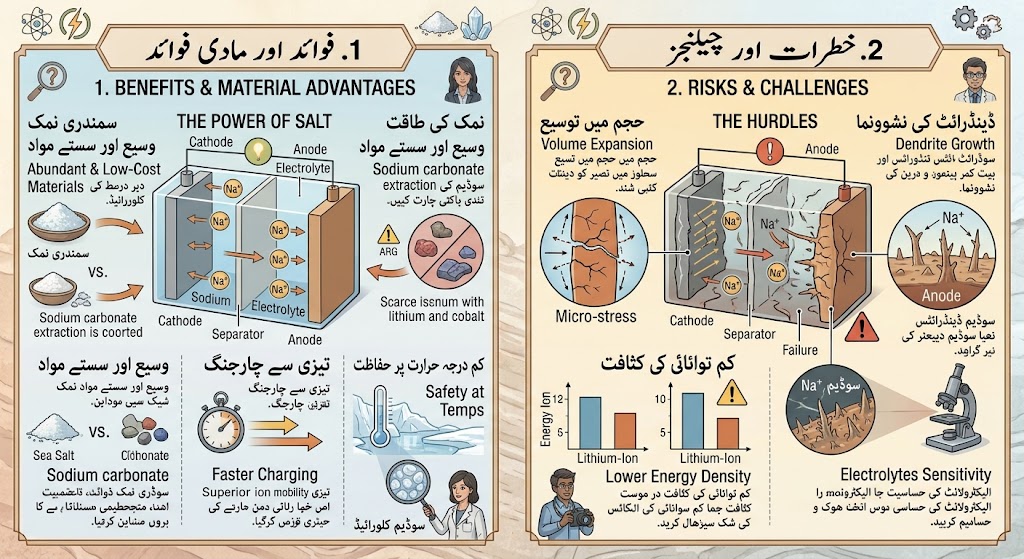
These developments could make sodium-ion batteries useful for renewable energy storage, low-cost vehicles, and applications requiring reliable performance in cold environments. However, they are not a perfect replacement for lithium-ion batteries. Understanding both their advantages and limitations is essential for evaluating their future potential.
How Sodium-Ion Battery Breakthroughs Work
Sodium-ion batteries operate through a process similar to that of lithium-ion batteries. During charging, sodium ions move through an electrolyte from one electrode to another. During discharging, these ions move back, while electrons travel through an external circuit to provide electricity.
A typical sodium-ion battery contains a cathode, an anode, an electrolyte, and a separator. The cathode stores sodium ions, while the anode provides a structure in which ions can be stored during charging. The electrolyte transports ions between the electrodes, and the separator helps prevent direct electrical contact between them.
The challenge is that sodium ions are larger than lithium ions. This difference affects how quickly ions move and how much energy a battery can store in a given amount of space. Researchers are developing improved materials to overcome these limitations and increase battery performance.
7 Major Sodium-Ion Battery Breakthroughs
1. Sodium-Ion Battery Breakthroughs in Advanced Cathode Materials
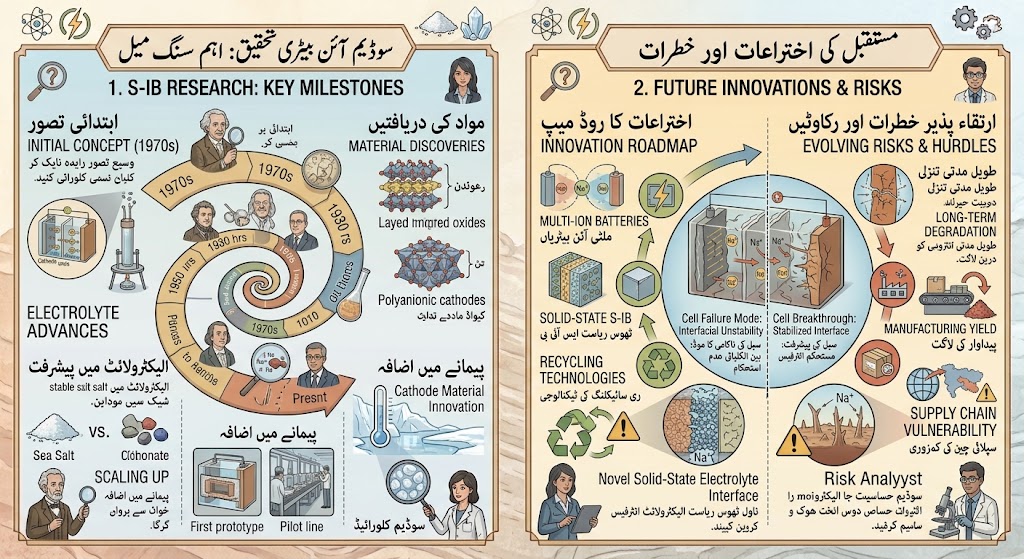
Cathode materials strongly influence battery capacity, operating voltage, stability, and lifespan. Researchers are investigating layered metal oxides, polyanionic compounds, and Prussian blue analogues to improve sodium-ion performance.
These materials offer different combinations of energy storage capacity, structural stability, and production costs. Some Prussian blue analogue materials are especially interesting because their open structures can support sodium-ion movement.
The main challenge is finding materials that maintain their structure over repeated charging cycles. Better cathodes could improve durability and help manufacturers produce more dependable batteries for energy storage and transportation.
2. Sodium-Ion Battery Breakthroughs in Hard-Carbon Anodes
Hard carbon is one of the leading anode materials for sodium-ion batteries. It can store sodium ions within its disordered structure, making it a practical candidate for rechargeable battery systems.
Researchers are studying how carbon structure, pore distribution, surface chemistry, and manufacturing methods affect storage capacity. Improvements may help batteries store more energy and reduce the amount of sodium lost during early charging cycles.
However, hard-carbon anodes still face challenges involving initial efficiency, material consistency, and energy density. Continued research is necessary before every laboratory improvement can translate into an affordable commercial product.
3. Sodium-Ion Battery Breakthroughs in Low-Temperature Performance
Cold weather can reduce the performance of many rechargeable batteries. Some sodium-ion designs offer promising low-temperature characteristics, making them attractive for applications in colder climates.
The International Energy Agency reported in 2026 that leading sodium-ion cells can retain around 90% of their nominal capacity at temperatures as low as -40°C. This performance depends on the particular battery design and operating conditions, so it should not be assumed for every sodium-ion product.
Improved cold-weather performance could support outdoor energy storage, certain electric vehicles, and equipment operating in challenging environments. Researchers must still evaluate charging safety, long-term durability, and real-world performance across different temperatures.
4. Sodium-Ion Battery Breakthroughs in Safer Electrolytes
Electrolytes help sodium ions travel between battery electrodes. Their chemical composition affects conductivity, temperature performance, battery lifespan, and safety.
Scientists are exploring improved liquid electrolytes, additives, and alternative electrolyte systems to reduce unwanted chemical reactions. Better control of the protective layers that form on electrode surfaces may also help batteries retain capacity over repeated cycles.
Nevertheless, sodium-ion batteries are not automatically risk-free. Many designs still use flammable liquid electrolytes, and poor manufacturing, physical damage, or improper charging can create safety hazards. Stronger testing and battery management systems remain essential.
5. Sodium-Ion Battery Breakthroughs for Renewable Energy Storage
Solar and wind power do not always produce electricity when demand is highest. Batteries can store surplus electricity and release it when generation falls or consumption increases.
Sodium-ion technology could become useful in stationary storage systems because these applications can often accommodate heavier batteries more easily than passenger vehicles can. Lower material costs, reliable cycling, and supply-chain diversity could make sodium-ion systems attractive for selected projects.
The overall economics depend on battery lifespan, installation costs, efficiency, maintenance, and the price of competing technologies. Sodium-ion batteries therefore represent a promising option rather than a guaranteed low-cost solution for every energy project.
6. Sodium-Ion Battery Breakthroughs in Manufacturing Efficiency
Another important area of research focuses on manufacturing methods. Sodium-ion batteries share several basic production principles with lithium-ion batteries, potentially allowing manufacturers to adapt some existing equipment and expertise.
Better production processes could reduce material waste, improve consistency, and increase the number of usable cells produced from each manufacturing batch. Research into electrode processing and quality control may also help make battery production more reliable.
However, existing factories cannot always switch chemistries without modifications. Different electrode materials, electrolyte requirements, and quality standards can require new equipment, testing, and investment.
7. Sodium-Ion Battery Breakthroughs in Long-Life Battery Design
Battery lifespan affects the total cost of storing electricity. A battery that lasts longer can reduce replacement costs and minimize the resources needed to manufacture new cells.
Researchers are investigating more stable electrode structures, improved electrolyte formulations, and better interfaces between battery components. These developments aim to slow degradation and maintain capacity over repeated charge-discharge cycles.
One promising research direction is self-healing electrode materials, designed to repair some microscopic damage that develops during cycling. Such approaches remain under investigation, and their commercial value will depend on whether they can deliver reliable improvements at an affordable manufacturing cost.
Benefits of Sodium-Ion Battery Breakthroughs
Sodium-ion batteries offer several potential benefits. The first is the widespread availability of sodium-containing raw materials, which could help diversify battery supply chains and reduce dependence on lithium. However, the total cost still depends on other components and manufacturing requirements.
Another potential benefit is performance in cold environments. Certain sodium-ion designs can retain useful capacity at low temperatures, making them suitable candidates for specialized energy applications.
Sodium-ion batteries may also be valuable for stationary electricity storage, where physical size and weight are often less restrictive than in electric vehicles. Their development could provide additional choices for storing renewable electricity and balancing power grids.
A further advantage is the possibility of reducing reliance on some critical minerals. The actual benefit depends on battery chemistry because certain sodium-ion designs still use materials such as nickel, manganese, or vanadium.
Hidden Risks of Sodium-Ion Battery Breakthroughs
Sodium-Ion Battery Breakthroughs and Lower Energy Density
Energy density remains a major limitation for many sodium-ion designs. A battery with lower energy density may need to be larger or heavier to store the same amount of electricity as a competing lithium-ion battery.
This difference can affect electric vehicle range, shipping expenses, and space requirements. Research continues to improve electrode materials and cell design, but sodium-ion batteries do not yet outperform every established lithium-ion chemistry in energy storage.
Sodium-Ion Battery Breakthroughs and Manufacturing Costs
Sodium may be inexpensive and abundant, but that does not automatically make finished batteries cheaper. Manufacturing facilities, material processing, quality control, and supply-chain development all contribute to final costs.
Lithium-ion production also benefits from extensive industrial experience and large-scale manufacturing. Sodium-ion technology must continue improving production efficiency to compete economically in different markets.
Sodium-Ion Battery Breakthroughs and Environmental Concerns
Battery production consumes energy and raw materials, while mining, chemical processing, transportation, and disposal can create environmental impacts.
Sodium-ion batteries could reduce reliance on certain resources, but their overall sustainability depends on the materials used and how the batteries are manufactured. Recycling systems must also be developed to recover valuable components and handle used cells safely.
Sodium-Ion Battery Breakthroughs and Limited Commercial Adoption
Commercial adoption remains another challenge. Manufacturers must demonstrate consistent performance, reliable supply, safety, and competitive costs before customers can confidently choose a new battery technology.
Although commercial sodium-ion products already exist, the technology remains a small part of the global battery industry. Wider adoption will depend on continued investment, successful manufacturing scale-up, and proven performance in real-world applications.
Sodium-Ion Battery Breakthroughs vs. Lithium-Ion Batteries
| Feature | Sodium-Ion Batteries | Lithium-Ion Batteries |
|---|---|---|
| Raw material availability | Sodium is widely available | Lithium supply is more geographically concentrated |
| Energy density | Generally lower today | Generally higher, depending on chemistry |
| Cold-weather potential | Promising in selected designs | Varies by chemistry and design |
| Manufacturing maturity | Developing | Highly established |
| Renewable energy storage | Promising for selected uses | Widely deployed |
| Supply-chain diversification | Potential advantage | Established but exposed to material concentration |
This comparison shows why sodium-ion batteries are better viewed as a complementary technology rather than a universal replacement for lithium-ion batteries.
Sodium-Ion Battery Breakthroughs: A Simple Technology Comparison
The following qualitative chart summarizes the major considerations when evaluating sodium-ion technology.
| Factor | Current outlook |
|---|---|
| Sodium availability | Very promising |
| Cold-temperature performance | Promising in selected designs |
| Energy density | Needs improvement |
| Manufacturing scale | Developing |
| Renewable energy applications | Strong potential |
| Recycling infrastructure | Requires further development |
These assessments are general and vary according to battery chemistry, manufacturer, and application. They are not measured scores or a ranking of individual commercial products.
Future of Sodium-Ion Battery Breakthroughs
The future of sodium-ion technology will depend on whether researchers can combine high performance with affordable and reliable manufacturing. Better cathodes, improved hard-carbon anodes, optimized electrolytes, and stronger electrode interfaces may help address current limitations.
Stationary storage is a particularly promising area because battery weight is often less important than cost, lifespan, safety, and dependable operation. Sodium-ion batteries may also find opportunities in selected vehicles, industrial equipment, and applications where cold-temperature performance matters.
The technology will still face competition from lithium iron phosphate batteries, other lithium-ion chemistries, and alternative energy storage systems. Successful commercialization will require evidence that sodium-ion batteries provide clear value for specific applications.
Conclusion: Sodium-Ion Battery Breakthroughs and Their Real Potential
Sodium-Ion Battery Breakthroughs could help diversify the global battery industry and support more affordable energy storage. Advances in cathode materials, hard-carbon anodes, electrolytes, low-temperature performance, and manufacturing are creating new opportunities for future applications.
However, lower energy density, production costs, material limitations, and recycling challenges remain important concerns. Sodium-ion batteries are not a perfect solution, but they could become a valuable part of a more diverse energy storage system.
The most important question is not whether sodium-ion batteries will replace every lithium-ion battery. It is whether continued research can make them a practical, competitive choice for the applications where their advantages matter most.
Frequently Asked Questions About Sodium-Ion Battery Breakthroughs
What Are Sodium-Ion Battery Breakthroughs?
Sodium-ion battery breakthroughs are improvements in electrode materials, electrolytes, battery design, and manufacturing that can increase performance, durability, safety, or affordability.
Are Sodium-Ion Battery Breakthroughs Better Than Lithium-Ion Batteries?
Not in every situation. Sodium-ion batteries offer potential benefits in raw material availability and selected cold-weather applications, while lithium-ion batteries generally offer higher energy density and more mature manufacturing.
Can Sodium-Ion Battery Breakthroughs Improve Renewable Energy Storage?
Yes. Sodium-ion batteries could help store solar and wind electricity, particularly in stationary applications where weight is less important than cost, durability, and reliable performance.
What Is the Biggest Risk of Sodium-Ion Battery Breakthroughs?
One of the biggest challenges is achieving competitive energy density and manufacturing costs while maintaining safety, long life, and consistent performance.
When Will Sodium-Ion Battery Breakthroughs Become More Common?
Commercial products already exist, but wider adoption will depend on manufacturing expansion, cost reductions, improved performance, and successful deployment across different applications.
SEO Tags for Sodium-Ion Battery Breakthroughs
Sodium-Ion Battery Breakthroughs, Sodium-Ion Batteries, Battery Research, Energy Storage Technology, Renewable Energy Storage, Sodium-Ion vs Lithium-Ion, Next-Generation Batteries, Clean Energy Innovation, Battery Technology Risks
Leave a Reply