AI Weather Forecasting Discoveries are transforming how scientists predict storms, monitor extreme weather, and understand changes in the atmosphere. Artificial intelligence can analyze enormous amounts of weather data and identify patterns that help produce forecasts more efficiently. These AI Weather Forecasting Discoveries offer hope for earlier warnings, better disaster preparation, and improved agricultural planning. However, hidden risks remain, including inaccurate predictions, limited training data, and difficulties forecasting unusual weather events. Understanding these developments helps explain how AI may improve weather forecasting while showing why scientific verification remains essential.
Table of Contents: AI Weather Forecasting Discoveries
- Introduction to AI Weather Forecasting Discoveries
- AI Weather Forecasting Discoveries in Extreme Weather Prediction
- AI Weather Forecasting Discoveries in Hurricane Forecasting
- AI Weather Forecasting Discoveries in Flood Prediction
- AI Weather Forecasting Discoveries in Climate Research
- AI Weather Forecasting Discoveries in Agricultural Planning
- AI Weather Forecasting Discoveries in Satellite Data Analysis
- AI Weather Forecasting Discoveries in Early Warning Systems
- AI Weather Forecasting Discoveries: Hope and Hidden Risks
- Conclusion on AI Weather Forecasting Discoveries
1. Introduction to AI Weather Forecasting Discoveries
Weather forecasting has traditionally depended on observations, mathematical equations, satellite measurements, and powerful numerical weather prediction models. These methods remain essential, but artificial intelligence is introducing new ways to analyze atmospheric conditions.
Machine learning systems can learn patterns from historical weather records and use them to predict future atmospheric conditions. Some modern AI forecasting models generate predictions much faster than traditional physics-based models, making them valuable tools for research and operational forecasting.
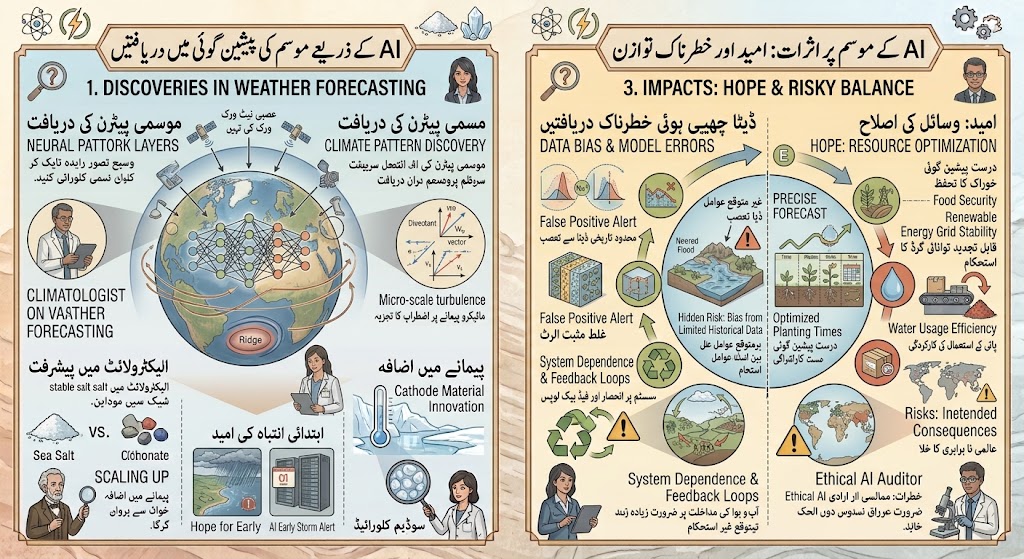
For example, GraphCast, developed by Google DeepMind, demonstrated that machine learning could produce competitive medium-range global weather forecasts across many evaluated variables. Other systems, including Pangu-Weather, have also demonstrated the potential of AI-based forecasting.
Nevertheless, AI does not understand every atmospheric process perfectly. Its predictions depend on input data, model design, and the weather conditions being forecast. The most useful AI Weather Forecasting Discoveries combine computational efficiency with careful evaluation and meteorological expertise.
2. AI Weather Forecasting Discoveries in Extreme Weather Prediction
Extreme weather events, such as heatwaves, severe storms, and unusually heavy rainfall, can threaten lives and damage infrastructure. Predicting these events early can help communities prepare and reduce potential losses.
AI systems can analyze historical observations, atmospheric measurements, and numerical forecast outputs to identify conditions associated with dangerous weather. They may help meteorologists recognize patterns that deserve closer investigation.
AI Weather Forecasting Discoveries for Earlier Warnings
Machine learning can support the prediction of certain extreme weather patterns by processing large datasets quickly. For example, an AI model may identify atmospheric conditions associated with a developing heatwave or a period of unusually heavy precipitation.
Early identification gives emergency services more time to prepare resources, issue warnings, and communicate with vulnerable communities. Farmers may also use forecasts to protect crops, while energy companies can prepare for changes in electricity demand during extreme temperatures.
However, rare weather events are difficult to predict because they may be poorly represented in historical training data. A model that performs well during ordinary conditions may struggle when atmospheric behavior becomes unusual.
AI predictions should therefore be tested against independent observations and established forecasting systems. Meteorologists must also communicate uncertainty instead of treating every prediction as a guaranteed outcome.
3. AI Weather Forecasting Discoveries in Hurricane Forecasting
Hurricanes and other tropical cyclones can cause destructive winds, storm surges, and intense rainfall. Forecasting their movement and intensity is essential for evacuation planning and emergency management.
AI models can examine atmospheric conditions, sea surface temperatures, historical cyclone tracks, and other relevant information. These models may help researchers estimate where a storm could travel and identify patterns associated with changes in its strength.
AI Weather Forecasting Discoveries for Storm Tracking
Some AI weather models have demonstrated promising performance in predicting large-scale atmospheric patterns and tropical cyclone tracks. Researchers are also investigating AI methods for estimating storm intensity and predicting rapid intensification.
Rapid intensification occurs when a tropical cyclone becomes substantially stronger over a short period. Predicting this process remains challenging because it depends on several interacting factors, including ocean heat, atmospheric moisture, wind shear, and internal storm structure.
AI can assist forecasting teams by analyzing these relationships, but it does not eliminate uncertainty. A small difference in a storm’s initial conditions may affect its predicted path or strength.
Reliable hurricane forecasting therefore benefits from combining AI guidance with satellite observations, physical weather models, specialist analysis, and repeated updates as new data become available.
4. AI Weather Forecasting Discoveries in Flood Prediction
Flooding can occur after prolonged rainfall, sudden downpours, overflowing rivers, or rapidly melting snow. Flash floods are especially dangerous because water levels may rise before communities have enough time to respond.
AI-based flood prediction systems can combine rainfall estimates, river measurements, soil moisture, terrain information, and historical flood records. These inputs can help estimate where flooding may occur and how conditions could develop.
AI Weather Forecasting Discoveries for Flash Flood Risks
Machine learning can identify relationships between rainfall intensity, land characteristics, and previous flooding. In some locations, these relationships can support faster local flood forecasts and improve the targeting of warnings.
For example, an urban area with limited drainage may experience dangerous flooding after heavy rain. An AI system that considers rainfall forecasts and local terrain could help authorities identify locations requiring additional monitoring.
However, flood prediction depends on reliable local information. In regions without sufficient river gauges, rainfall measurements, or historical records, predictions may be less dependable. Unexpected changes in drainage systems and land use can also reduce model accuracy.
AI should therefore complement, rather than replace, hydrological modeling, ground-based sensors, and emergency planning. Effective flood warnings also need clear communication so that people understand what action to take.
5. AI Weather Forecasting Discoveries in Climate Research
Weather forecasting and climate research are related but different. Weather forecasts estimate atmospheric conditions over shorter periods, while climate research examines long-term patterns, trends, and changes in the climate system.
AI can help researchers process large climate datasets, analyze satellite observations, and identify patterns across long periods. These methods may support studies of temperature changes, rainfall variability, and extreme weather risks.
AI Weather Forecasting Discoveries for Climate Analysis
Researchers are exploring machine learning to improve the analysis of climate simulations and to identify relationships among atmospheric and oceanic conditions. AI may also help make certain climate-modeling tasks more computationally efficient.
For example, scientists can use machine learning to investigate how changes in temperature and moisture relate to regional rainfall patterns. Such analysis can contribute to understanding potential risks to agriculture, water resources, and infrastructure.
However, a weather prediction model should not automatically be treated as a reliable climate projection system. Long-term climate projections must account for greenhouse gas emissions, ocean circulation, land processes, and other physical factors.
AI-generated results need to be evaluated against established scientific knowledge and observed data. Researchers must also explain the assumptions and limitations behind their conclusions.
6. AI Weather Forecasting Discoveries in Agricultural Planning
Agriculture depends heavily on weather. Farmers need information about rainfall, temperature, humidity, wind, and possible extreme events to decide when to plant, irrigate, fertilize, and harvest crops.
AI-assisted forecasting can help translate weather information into useful agricultural guidance. When combined with crop information and local observations, forecasts may help farmers plan field operations and manage limited water supplies.
AI Weather Forecasting Discoveries for Smarter Farming
For example, a forecast of heavy rainfall may help a farmer delay irrigation or protect harvested crops. Predictions of high temperatures may support planning for heat-sensitive crops, livestock, and agricultural workers.
AI systems can also combine weather information with soil moisture sensors and satellite images to help estimate water needs. These tools may be particularly useful in areas where changing rainfall patterns create uncertainty for farming communities.
Nevertheless, forecasts can be less accurate at very local scales, especially when weather varies significantly across short distances. Farmers should not rely on a single automated prediction for every decision.
The most effective systems combine AI forecasts with local weather stations, agricultural expertise, and advice suited to regional growing conditions. Access and affordability also matter because smaller farms may not have the resources to adopt advanced digital tools.
7. AI Weather Forecasting Discoveries in Satellite Data Analysis
Satellites provide essential information about clouds, atmospheric moisture, temperatures, storms, and other features of the Earth system. Modern weather services receive enormous quantities of satellite observations that must be processed and interpreted.
AI can help analyze these observations, recognize cloud patterns, estimate atmospheric properties, and identify developing weather systems. This allows researchers to extract useful information from complex images and measurements.
AI Weather Forecasting Discoveries for Faster Satellite Insights
Machine learning can support the detection of cloud formations associated with storms and help process observations from multiple instruments. AI tools may also assist in identifying missing or inconsistent data that require additional review.
In regions where ground-based weather stations are limited, satellite observations can be particularly valuable. Combining satellite data with other measurements may help improve weather monitoring over oceans, mountains, and remote areas.
However, satellites do not measure every atmospheric variable directly. Some information must be estimated from the observations, and those estimates contain uncertainty. Clouds, sensor limitations, and incomplete coverage can also affect data quality.
AI systems must therefore be evaluated carefully to ensure that their interpretations remain scientifically reliable. High-quality observations are fundamental to accurate forecasting, regardless of how advanced a model may be.
8. AI Weather Forecasting Discoveries in Early Warning Systems
Early warning systems connect weather predictions with communication and emergency response. A technically accurate forecast is not enough if people do not receive the warning in time or understand how to respond.
AI can help identify developing hazards, combine information from different monitoring systems, and support decisions about when additional attention may be needed. These capabilities may improve how authorities organize information during dangerous weather conditions.
AI Weather Forecasting Discoveries for Community Safety
An early warning system might combine forecasts of heavy rainfall with river-level sensors and local flood-risk maps. If conditions indicate an increasing threat, authorities can review the information and communicate suitable warnings to affected communities.
Similarly, heat-risk forecasts may help health services prepare for periods of extreme temperatures. Weather-related warnings can also support transportation planning and the protection of essential infrastructure.
However, AI-generated warnings can create problems if they are inaccurate, unclear, or issued too frequently. False alarms may reduce public trust, while missed warnings can expose communities to danger.
Effective systems need reliable communication channels, accessible language, clear responsibility, and procedures for human review. Communities should also have practical guidance explaining what to do when a warning is issued.
9. AI Weather Forecasting Discoveries: Hope and Hidden Risks
AI offers important opportunities to improve weather forecasting, but its limitations must be understood. Different models perform differently depending on the forecasting task, available data, geographic region, and prediction period.
AI Weather Forecasting Discoveries and Their Main Benefits
AI models can process large datasets efficiently and may provide useful forecasts at relatively low computational cost once trained. They can also support rapid analysis and help researchers explore patterns that are difficult to identify manually.
These capabilities may improve preparation for storms, floods, heatwaves, and other hazards. Better forecasting can support decisions in agriculture, transport, energy, and emergency management.
AI Weather Forecasting Discoveries and Hidden Risks
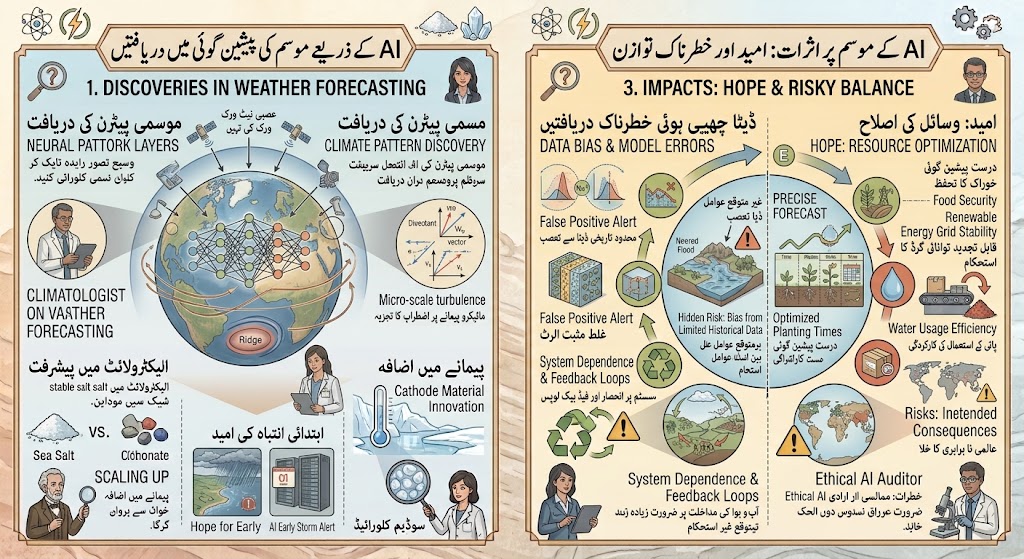
One major risk is that AI models can produce inaccurate predictions when they encounter weather conditions that differ from their training data. Limited observations in some regions may also make forecasts less dependable.
Another challenge is transparency. Some complex models are difficult to interpret, making it harder to explain why a particular prediction was produced. AI forecasts may also inherit errors or biases from the data used to train them.
Researchers should compare AI predictions with trusted forecasting methods, evaluate performance across different regions, and communicate uncertainty clearly. Human meteorologists remain important for interpreting results and making high-impact decisions.
The future of AI forecasting will depend not only on faster models but also on reliable observations, rigorous scientific testing, accessible warnings, and responsible use of technology.
10. Conclusion on AI Weather Forecasting Discoveries
AI Weather Forecasting Discoveries are changing how researchers analyze atmospheric conditions and predict weather-related risks. From extreme weather and hurricane tracking to flood prediction, climate research, and agricultural planning, AI can provide useful tools for understanding complex environmental systems.
Yet these technologies are not perfect. Data gaps, unusual weather conditions, and uncertain predictions can limit their performance. AI forecasts must be evaluated carefully and combined with scientific expertise before they guide critical decisions.
The greatest benefit will come when advanced forecasting technology is connected to effective early warning systems and practical community action. With continued research and responsible implementation, AI can help society prepare for dangerous weather while improving the way people understand and respond to changing atmospheric conditions.
Leave a Reply