8 Powerful Perovskite Solar Breakthroughs: Hope & Risks
Introduction to Perovskite Solar Breakthroughs
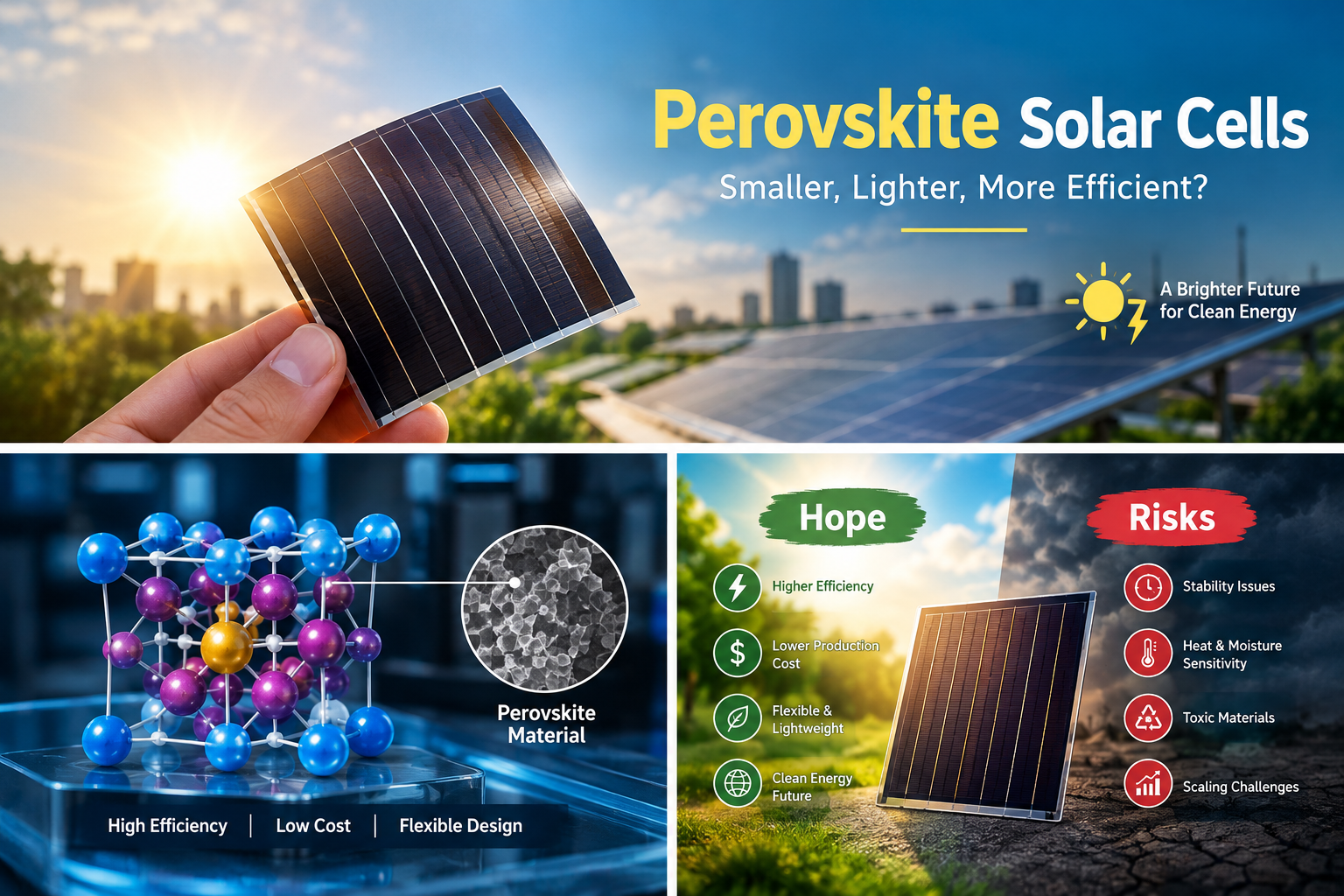
Perovskite Solar Breakthroughs are creating new possibilities for renewable energy by exploring solar cells that can convert sunlight into electricity using specially engineered materials. Traditional solar panels commonly use silicon, but perovskite solar cells use materials with a particular crystal structure that can absorb light efficiently. Researchers are investigating these materials because they offer potential advantages in manufacturing, lightweight applications, and the development of next-generation solar technologies.
One of the most exciting possibilities is combining perovskite materials with silicon to create tandem solar cells. These devices can capture different portions of the solar spectrum, potentially producing more electricity from the same amount of sunlight. Other research focuses on improving durability, reducing manufacturing costs, and developing flexible solar applications.

However, Perovskite Solar Breakthroughs also face significant challenges. Moisture, heat, ultraviolet exposure, and material degradation can affect performance. Some perovskite formulations contain lead, raising concerns about environmental protection and recycling. Understanding both the opportunities and risks is essential for evaluating whether this technology can become a reliable part of the global clean-energy transition.
Table of Contents
- Perovskite Solar Breakthroughs in High-Efficiency Cells
- Perovskite-Silicon Tandem Solar Technology
- Flexible and Lightweight Solar Panels
- Improved Durability and Stability
- Low-Cost Solar Manufacturing
- Lead-Free Perovskite Research
- AI-Powered Solar Cell Development
- Recycling and Environmental Protection
- Comparison Table and Technology Graph
- Future Outlook and Conclusion
1. Perovskite Solar Breakthroughs in High-Efficiency Cells
One of the most important Perovskite Solar Breakthroughs involves improving the efficiency of solar cells. Efficiency describes the proportion of incoming sunlight that a solar device converts into electrical energy under specified testing conditions.
Perovskite materials have attracted attention because their optical and electronic properties can be adjusted by changing their chemical composition and structure. Researchers are studying ways to reduce defects in the material, improve the movement of electrical charges, and limit energy losses inside the device.
These improvements can help more of the absorbed sunlight contribute to electricity generation. Laboratory research has produced impressive results, making perovskites an important area of next-generation photovoltaic development.
However, laboratory efficiency does not automatically translate into reliable commercial performance. Small experimental cells are generally easier to control than large modules exposed to outdoor weather. Manufacturing consistency, long-term stability, and the cost of producing usable electricity must also be considered.
The next challenge is therefore to maintain high efficiency while making devices durable, affordable, and suitable for real-world installation.
2. Perovskite-Silicon Tandem Solar Technology
Perovskite-silicon tandem technology is among the most promising Perovskite Solar Breakthroughs. Traditional silicon solar cells are effective at converting sunlight into electricity, but they cannot use every part of the solar spectrum equally well.
A tandem cell combines two light-absorbing layers with different properties. The upper perovskite layer can capture portions of sunlight that complement the light absorbed by the silicon layer beneath it. When carefully designed, the two layers can generate more electricity than a comparable single-junction cell.
This approach could increase the energy output of solar installations without requiring a proportional increase in panel area. It may be particularly valuable where rooftop space is limited or where higher power production is economically important.

Nevertheless, tandem cells are more complicated to manufacture than conventional silicon devices. The layers must work together electrically, remain stable under sunlight, and withstand temperature changes. Manufacturing defects or degradation in one layer can affect the performance of the entire device.
Researchers are working to improve production methods, interface quality, and long-term reliability. If these challenges are addressed, tandem solar technology could become an important option for future solar power systems.
3. Flexible and Lightweight Solar Panels
Another exciting area of Perovskite Solar Breakthroughs is the development of lightweight and potentially flexible solar devices. Certain perovskite solar cells can be manufactured on thin substrates, creating opportunities beyond conventional rigid glass panels.
Researchers are investigating possible uses in portable electronics, building surfaces, transportation applications, and structures where weight is an important consideration. Flexible solar devices could eventually help supply electricity to selected surfaces that are unsuitable for heavy traditional panels.
Some designs may also support semi-transparent solar applications, allowing sunlight to pass through part of a device while generating electricity. This could be useful for certain windows, facades, and architectural systems.
However, flexibility introduces engineering challenges. Bending can damage delicate layers or electrical contacts, while protective coatings may add weight or reduce flexibility. Outdoor applications also require resistance to water, oxygen, heat, and ultraviolet radiation.
A flexible solar cell that works well during a short laboratory test may not survive years of daily use. Researchers must therefore evaluate mechanical durability and long-term energy output before these products can be considered dependable alternatives.
4. Improved Durability and Stability
Durability is one of the biggest challenges facing Perovskite Solar Breakthroughs. Although perovskite solar cells can achieve high efficiency in laboratory conditions, maintaining that performance over many years remains essential for commercial success.
Moisture and oxygen can damage sensitive material compositions. Heat may accelerate chemical changes, while prolonged exposure to light can affect the material and the interfaces between its layers. These problems can cause power output to decline over time.
Researchers are exploring several approaches to improve stability. Protective encapsulation can help limit exposure to the surrounding environment. Material engineering may reduce unwanted chemical reactions, while improved interfaces can support more stable charge transport.
Testing is equally important. Scientists need to examine devices under controlled heat, humidity, illumination, and other stress conditions. Outdoor testing can reveal problems that short laboratory experiments may miss.
Improved durability could make perovskite technology more attractive to manufacturers and investors. However, accelerated testing must be interpreted carefully because it does not always predict real-world performance perfectly. Commercial success will depend on proven reliability, warranties, and consistent manufacturing quality.
5. Low-Cost Solar Manufacturing
Perovskite Solar Breakthroughs have attracted interest partly because some perovskite layers can be deposited using solution-based or other potentially low-temperature manufacturing processes. Depending on the design, these methods may require less energy for certain production steps than some conventional manufacturing approaches.
Researchers are investigating coating, printing, and deposition techniques that could produce solar materials over larger areas. Scalable manufacturing may reduce material waste and help make production more efficient.
Lower manufacturing costs could make solar technology accessible in a wider range of applications. However, the cost of the active material is only one part of the total expense. Industrial production also requires quality control, protective packaging, electrical connections, equipment, and testing.
Some manufacturing processes can struggle to produce uniform layers over large surfaces. Small defects may reduce efficiency or create reliability problems, increasing the cost of rejected products.
For this reason, the real economic advantage must be measured across the complete manufacturing process. Perovskite solar technology will need to demonstrate competitive lifetime energy production, dependable quality, and practical installation costs before its potential savings can be fully realized.
6. Lead-Free Perovskite Research
Environmental safety is another important area of Perovskite Solar Breakthroughs. Many high-performing perovskite solar cells use lead-containing compounds, which can create environmental concerns if damaged modules are not handled properly.
Researchers are investigating alternative compositions that replace lead with other elements. Tin-based perovskites are one example, although they can face challenges involving oxidation and material stability. Other alternative compositions are also being explored, but they do not automatically match the efficiency and durability of established lead-containing formulations.
The objective is to develop materials that combine useful electrical properties with improved environmental characteristics. Scientists must consider the toxicity of the complete material system, its manufacturing requirements, and the potential effects of its breakdown products.
Lead-containing devices may also be designed with protective barriers and controlled collection systems to reduce the likelihood of harmful material release. These measures, however, need to be tested under realistic conditions.
A successful solution will require both safer materials and responsible product management. Researchers must evaluate environmental impacts throughout the product life cycle rather than judging safety from a single ingredient alone.
7. AI-Powered Solar Cell Development
Artificial intelligence is creating new opportunities to accelerate Perovskite Solar Breakthroughs. Developing solar materials traditionally involves repeated experiments in which scientists adjust chemical compositions, processing conditions, and device structures.
Machine-learning systems can analyze experimental results and help identify patterns associated with better performance or stability. When supported by reliable data, these models may help researchers prioritize promising material combinations and reduce unnecessary experiments.
AI can also assist with image analysis, defect identification, production monitoring, and the interpretation of complex laboratory measurements. Automated laboratories may combine machine-learning predictions with robotic experiments to test candidate materials more efficiently.
However, AI predictions are not guaranteed to be correct. Models trained on limited or inconsistent datasets may recommend materials that perform poorly outside the original experimental conditions. Experimental verification remains essential.
Researchers also need to share reliable measurements and document unsuccessful experiments where appropriate. Better data quality can help models make more useful predictions.
The strongest approach combines computational tools with laboratory testing and materials science expertise. AI may speed up the research process, but practical breakthroughs still require evidence that a device performs reliably.
8. Recycling and Environmental Protection
Recycling is an essential part of the long-term future of Perovskite Solar Breakthroughs. Solar modules are designed to produce electricity for many years, but eventually they may need repair, replacement, or disposal.
Perovskite devices can contain several thin layers, electrodes, protective materials, and substrates. Recovering useful materials without creating additional environmental problems requires carefully designed processes.
Researchers are exploring methods to recover valuable components and manage lead-containing materials safely. Better module design may also make it easier to separate layers during recycling. Manufacturers could help by documenting material composition and supporting collection systems.
Recycling alone will not solve every environmental concern. Facilities must be able to collect used modules, process them safely, and handle recovered materials responsibly. Transport and processing also have environmental costs.
A comprehensive assessment should compare the energy and materials required for production with the electricity generated over the module’s lifetime. It should also consider waste management, resource recovery, and potential contamination.
If durability, material recovery, and safe disposal improve together, perovskite solar technology could become a more responsible part of the renewable-energy industry.
9. Perovskite Solar Breakthroughs Comparison Table
The following table summarizes the main research directions, their potential advantages, and the challenges that still need to be addressed.
| Research breakthrough | Potential advantage | Main challenge |
|---|---|---|
| High-efficiency cells | Greater sunlight conversion | Maintaining performance at scale |
| Silicon tandem cells | More electricity per unit of area | Manufacturing complexity |
| Flexible solar devices | Lightweight applications | Mechanical durability |
| Stability improvements | Longer operating life | Heat, moisture, and light degradation |
| Low-cost manufacturing | Potentially efficient production | Consistent large-scale quality |
| Lead-free materials | Reduced reliance on lead | Efficiency and stability trade-offs |
| AI-assisted research | Faster materials screening | Data quality and validation |
| Recycling technology | Improved material recovery | Safe, economical processing |
10. Future Outlook for Perovskite Solar Breakthroughs
The future of Perovskite Solar Breakthroughs will depend on more than achieving impressive laboratory efficiency. Researchers must demonstrate that solar cells can be manufactured consistently, remain stable in real-world conditions, and generate electricity at competitive lifetime costs.
Tandem solar technology could provide a route to higher performance, while improved encapsulation and manufacturing controls may address some durability concerns. AI-assisted materials research could also help scientists investigate promising compositions more efficiently.
Environmental responsibility will remain essential. Safer material choices, appropriate protective designs, and practical recycling systems will influence how widely this technology can be adopted.
Commercial deployment will also depend on manufacturing investment, independent testing, industry standards, and customer confidence. Different applications may require different solutions: a device designed for a controlled indoor environment may not need the same durability as a solar panel installed outdoors for decades.
Perovskite technology is promising, but its future should be evaluated through independently verified efficiency, reliability, safety, and cost data. Progress across these areas will determine whether it becomes a major complement to conventional silicon solar panels.
Conclusion
Perovskite Solar Breakthroughs offer promising opportunities to improve solar efficiency, develop tandem devices, support lightweight applications, and explore new manufacturing methods. Research into stability, lead-free materials, AI-assisted discovery, and recycling may also help address important technical and environmental challenges.
However, high laboratory efficiency does not guarantee long-term commercial success. Durability, large-scale production, environmental protection, and recycling must all improve together.
The most valuable advances will be those that combine strong performance with proven reliability and responsible material management. Perovskite solar technology may not replace every conventional solar panel, but it could become an important part of a cleaner and more efficient energy future.