Introduction to Humanoid Robot Breakthroughs
Humanoid robot breakthroughs are changing the way people think about artificial intelligence, automation, and the future of work. These advanced robots are designed to resemble humans in their body structure, movements, and ability to interact with their surroundings. With improvements in artificial intelligence, computer vision, sensors, and robotic engineering, humanoid robots are becoming more capable of performing tasks that once required human involvement.
The growing interest in humanoid robot breakthroughs brings both hope and concern. On the positive side, humanoid robots may help older adults, support workers in dangerous environments, and reduce repetitive tasks. However, their development also raises questions about job security, privacy, safety, and the cost of advanced technology. Understanding these opportunities and risks is important as humanoid robots move from laboratories into workplaces and other real-world environments.
Table of Contents
- The Rise of Humanoid Robot Breakthroughs
- Artificial Intelligence and Human-Like Decisions
- Humanoid Robot Breakthroughs in Healthcare
- Advanced Movement and Dexterous Hands
- Humanoid Robots in Industrial Workplaces
- The Hidden Risks of Humanoid Robot Breakthroughs
- The Future of Humanoid Robot Breakthroughs
- Frequently Asked Questions
H2: The Rise of Humanoid Robot Breakthroughs
Humanoid robots have developed significantly from machines that could perform only simple, programmed movements. Modern systems can combine cameras, motion sensors, machine-learning models, and advanced actuators to recognize objects and respond to changes in their environment. Some robots can walk across uneven surfaces, carry objects, or follow spoken instructions under controlled conditions.
A major reason for this progress is the connection between robotics and artificial intelligence. Traditional industrial robots generally repeat carefully programmed actions in fixed locations. Humanoid robots are being developed to operate in spaces designed for people, potentially allowing them to use existing doors, workstations, tools, and equipment.

Nevertheless, human-like appearance does not mean human-level intelligence. A robot may complete a demonstration successfully but struggle with unfamiliar objects, unexpected obstacles, or complicated environments. Real progress must be measured through reliability, safety, useful work, and performance over time rather than appearance alone.
H2: Artificial Intelligence in Humanoid Robot Breakthroughs
Artificial intelligence is one of the most important technologies behind humanoid robot breakthroughs. AI systems help robots interpret visual information, understand certain spoken commands, recognize objects, and select actions. Combining language models with robotic control may also make it easier for people to give instructions without learning specialized programming languages.
For example, a worker might ask a robot to move a container to a designated workstation. The robot would need to understand the instruction, locate the container, plan a safe route, grasp the object, and place it correctly. Every step requires a combination of perception, planning, and physical control.
These capabilities are promising, but AI systems can misunderstand instructions or make incorrect predictions. A robot operating around people must therefore use reliable safety mechanisms and recognize when it cannot complete a task confidently. Human supervision remains important, especially in environments where an incorrect movement could cause injury or damage.
H2: Humanoid Robot Breakthroughs in Healthcare
Healthcare is a promising area for humanoid robot research because hospitals, rehabilitation centers, and care facilities often require repetitive physical assistance. In the future, suitable robots could help transport supplies, deliver lightweight items, guide visitors, or assist staff with routine logistical work.
Humanoid robots might also support older adults by retrieving everyday objects or helping them communicate with caregivers. Their human-oriented design could make them useful in spaces where existing equipment was built for people. However, physical assistance involving lifting, walking support, or personal care requires particularly careful engineering and testing.
Robots should complement healthcare professionals rather than replace the human judgment, empathy, and responsibility essential to patient care. Privacy is another major concern because care robots may use microphones, cameras, and other sensors around sensitive personal information. Successful adoption will depend on secure data practices, clear consent, affordability, and proven safety.
H2: Advanced Movement in Humanoid Robot Breakthroughs
Walking, balancing, and manipulating objects are among the most difficult challenges in humanoid robotics. Unlike wheeled machines, bipedal robots must continually manage balance while responding to changing surfaces and external forces. Researchers use advanced control systems, sensors, and carefully designed actuators to improve stability and coordination.

Hands are equally important. Human environments contain objects of different shapes, weights, textures, and sizes. A robot needs to apply enough force to hold an object securely without crushing it or allowing it to slip. Developing this level of dexterity remains a complex engineering challenge.
Progress in movement could eventually help robots perform practical activities such as sorting packages, carrying tools, opening certain doors, and handling materials. However, impressive laboratory demonstrations do not automatically prove that a robot can perform these activities safely for a full working shift. Battery life, maintenance, speed, and reliability all influence real-world usefulness.
H2: Humanoid Robot Breakthroughs in Industrial Workplaces
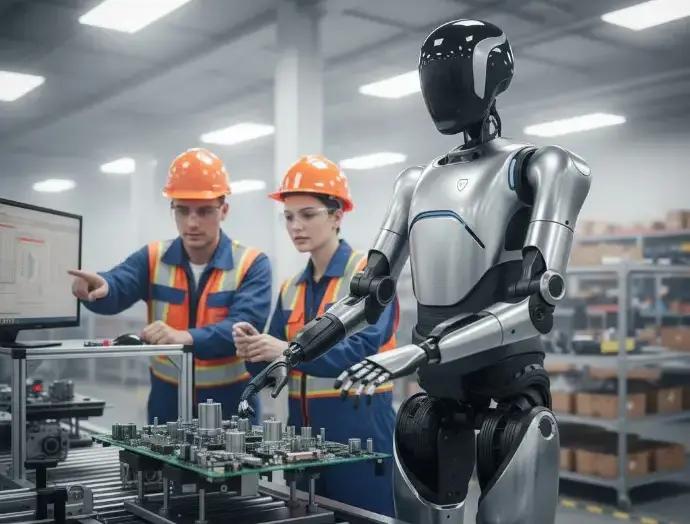
Factories, warehouses, and distribution centers are potential environments for humanoid robot breakthroughs. These workplaces contain repetitive tasks that can be physically demanding, time-consuming, or hazardous. A capable humanoid robot might move supplies, transfer objects between workstations, or assist with selected inspection and material-handling activities.
One possible advantage is flexibility. A humanoid robot designed to work with human-sized equipment may not require every workstation to be completely redesigned. This could be useful in certain environments where changing an entire production line would be expensive. Even so, specialized robotic arms and automated guided vehicles may remain cheaper and more efficient for many established tasks.
Companies must evaluate the complete cost of deployment, including purchasing equipment, electricity, training, software, repairs, and downtime. They must also consider how automation affects employees. Retraining programs and thoughtful workplace planning can help workers transition toward technical supervision, maintenance, and other roles as technology evolves.
H2: The Hidden Risks of Humanoid Robot Breakthroughs
Despite their potential benefits, humanoid robot breakthroughs introduce risks that should not be ignored. The first is physical safety. A large robot can cause injury if it loses balance, misinterprets a nearby person’s movement, or experiences a mechanical failure. Developers must build appropriate safeguards, emergency stops, and reliable testing procedures into these systems.
The second concern is employment. Automation may reduce demand for certain repetitive tasks, although it can also create opportunities in robotics maintenance, engineering, programming, and system management. The overall effect will vary across industries, locations, and occupations. Governments, employers, and educational institutions will need to support workers who require new skills.
Privacy and cybersecurity are additional challenges. Robots that collect video, audio, maps, or workplace information could expose sensitive data if their systems are poorly secured. Unauthorized access might also disrupt operations or create physical hazards. Strong access controls, software updates, data minimization, and independent security testing are essential.
Finally, high development and maintenance costs may prevent smaller organizations from benefiting from this technology. Humanoid robots will deliver meaningful value only when their capabilities justify their expense and their risks can be managed responsibly.
H2: The Future of Humanoid Robot Breakthroughs
The future of humanoid robot breakthroughs will depend on improvements in AI, batteries, sensors, mechanical design, and real-world testing. Better software may help robots understand instructions and adapt to new situations, while improvements in energy storage could increase their useful operating time. More capable hands and safer movement systems may also expand the range of tasks they can perform.
However, adoption is unlikely to happen at the same speed in every industry. Businesses will generally favor robots that solve clear problems, operate reliably, and provide measurable value. Some environments may benefit from humanoid robots, while others will continue using simpler and more specialized machines.
Responsible development will require collaboration among researchers, manufacturers, workers, regulators, and the public. Clear safety standards, transparent testing, and fair policies for affected employees can help ensure that technological progress benefits society.
The greatest opportunity is not simply to create machines that look like humans. It is to build reliable tools that help people accomplish useful work while protecting safety, privacy, and human dignity.
H2: Frequently Asked Questions About Humanoid Robot Breakthroughs
H3: What are humanoid robot breakthroughs?
Humanoid robot breakthroughs are advances in robots designed with human-like body structures, movement, sensing, and interaction. These improvements may help robots perform practical tasks in environments designed for people.
H3: Can humanoid robots replace human workers?
Some robots may automate particular tasks, especially repetitive or physically demanding ones. However, widespread replacement is not guaranteed. Cost, reliability, safety, and the need for human judgment will influence where these robots are useful.
H3: Are humanoid robots safe?
Humanoid robots can be designed with safety features, but no system should be assumed safe simply because it works during a demonstration. Proper testing, supervision, maintenance, and emergency procedures are essential.
H3: What is the biggest challenge for humanoid robots?
Major challenges include reliable movement, dexterous object handling, battery life, understanding unfamiliar situations, safety, and cost. Solving these problems is essential before robots can work dependably in many everyday environments.
Conclusion: Humanoid Robot Breakthroughs and a Better Future
Humanoid robot breakthroughs offer exciting possibilities for industry, healthcare support, and everyday assistance. Advances in artificial intelligence, movement, and object handling may enable robots to take on useful tasks in human environments. At the same time, employment disruption, privacy concerns, cybersecurity threats, and physical safety risks require serious attention.
A better future will depend on responsible innovation rather than speed alone. By testing robots carefully, protecting personal data, supporting workers, and choosing applications where robots provide genuine value, society can pursue the benefits of humanoid robotics while reducing its hidden risks.
Leave a Reply