Table of Contents
- Introduction to Virtual Cell Discoveries
- What Are Virtual Cell Discoveries?
- Virtual Cell Discoveries in Drug Development
- Virtual Cell Discoveries and Personalized Medicine
- Virtual Cell Discoveries in Disease Research
- Virtual Cell Discoveries and Artificial Intelligence
- Virtual Cell Discoveries: Benefits and Risks
- Future of Virtual Cell Discoveries
- Conclusion
Introduction to Virtual Cell Discoveries
Virtual Cell Discoveries are opening exciting possibilities for modern biology by helping scientists understand how cells work through computer-based models. These models can combine biological information, mathematical simulations, and artificial intelligence to explore cellular behavior. Instead of relying entirely on laboratory experiments, researchers can use virtual cells to investigate how cells might respond to different conditions.
The growing interest in Virtual Cell Discoveries offers hope for faster scientific research, improved drug development, and a deeper understanding of diseases. However, these technologies also face challenges, including incomplete biological data, inaccurate predictions, and high computational costs. Understanding both the opportunities and limitations is essential for using virtual cells responsibly.
What Are Virtual Cell Discoveries?
Virtual Cell Discoveries involve developing and studying computational representations of living cells. These representations may simulate selected cellular processes, such as gene activity, protein interactions, metabolism, and responses to environmental changes.
A virtual cell does not necessarily reproduce every part of a real biological cell. Some models focus on one process, while more advanced systems attempt to connect multiple biological activities into a broader simulation.
Scientists build these models using experimental measurements, biological databases, mathematical methods, and machine learning. They then compare model predictions with real observations to determine whether the simulations accurately represent biological behavior.
This approach can help researchers generate hypotheses before conducting laboratory experiments. Nevertheless, virtual models are tools for scientific investigation rather than perfect replacements for living cells.
Virtual Cell Discoveries in Drug Development
One promising area for Virtual Cell Discoveries is drug development. Creating a new medicine can require years of research, extensive testing, and substantial financial investment. Researchers must understand how potential treatments affect biological systems and whether those effects could be harmful.
Virtual cell models can help scientists investigate how a candidate drug might influence cellular pathways. Researchers may use simulations to identify possible mechanisms of action, compare treatment strategies, and determine which experiments deserve further investigation.
For example, a model of a cancer cell could help researchers explore how changes in particular proteins might influence its response to a potential treatment. The predictions would still need experimental validation, but they could help scientists develop more focused research questions.
Virtual Cell Discoveries may therefore improve the efficiency of early-stage drug research. They cannot independently establish that a medicine is safe or effective in humans, and clinical studies remain essential.
Virtual Cell Discoveries and Personalized Medicine
Personalized medicine aims to make healthcare decisions more appropriate for individual patients. People can respond differently to the same treatment because of genetic differences, medical histories, and other biological factors.
Virtual Cell Discoveries could support this approach by helping scientists model how cellular systems respond to different conditions. When models incorporate reliable patient-specific information, researchers may investigate why a treatment works well for one person but less effectively for another.
For instance, scientists could study how variations in a biological pathway influence the response of particular cells to a medicine. Such research may eventually contribute to better treatment selection and more targeted therapies.
However, a virtual cell model cannot yet guarantee the best treatment for an individual patient. Human health involves complex interactions among many cells, tissues, organs, and environmental influences. More research is needed before many personalized virtual-cell applications can become routine clinical tools.
Virtual Cell Discoveries in Disease Research
Understanding disease requires scientists to examine changes in cellular behavior. Infections, cancer, metabolic disorders, and genetic conditions can involve complicated interactions among genes, proteins, and other cellular components.
Virtual Cell Discoveries allow researchers to investigate some of these interactions within a computational environment. By changing one variable at a time, scientists can explore possible explanations for observed biological patterns and identify areas that require additional testing.
In cancer research, for example, computational models may help investigate how signaling pathways influence cell growth. In infectious disease research, researchers may simulate selected interactions between pathogens and host cells.
These approaches can generate useful hypotheses and reveal relationships that might otherwise be difficult to examine. However, the quality of the results depends on the model’s assumptions and the evidence used to build it. A simulation that overlooks an important biological mechanism may produce misleading conclusions.
Virtual Cell Discoveries and Artificial Intelligence
Artificial intelligence is becoming an important part of computational biology. Machine learning systems can analyze large biological datasets, recognize patterns, and help researchers predict relationships between cellular components.
Virtual Cell Discoveries can benefit from these capabilities when AI tools are combined with established biological knowledge and experimental evidence. For example, machine learning may help estimate how gene activity changes under different conditions or identify patterns in cellular imaging data.
AI-assisted models may also help scientists connect information from different experiments. This could make it easier to investigate complicated biological systems and develop new research hypotheses.
Despite these advantages, AI predictions are not automatically correct. Models may learn biases from incomplete datasets or perform poorly when applied to biological conditions they have not encountered before. Independent testing, transparent methods, and expert review are necessary to assess the reliability of their results.
Virtual Cell Discoveries: Benefits and Risks
Virtual Cell Discoveries offer several potential benefits for scientific research. Computational experiments can allow researchers to test ideas before investing resources in laboratory studies. They may also help organize large amounts of biological information and identify promising directions for future experiments.
Another advantage is the ability to investigate hypothetical scenarios that may be difficult to test directly. Scientists can adjust model parameters, compare possible outcomes, and study how selected biological processes interact.
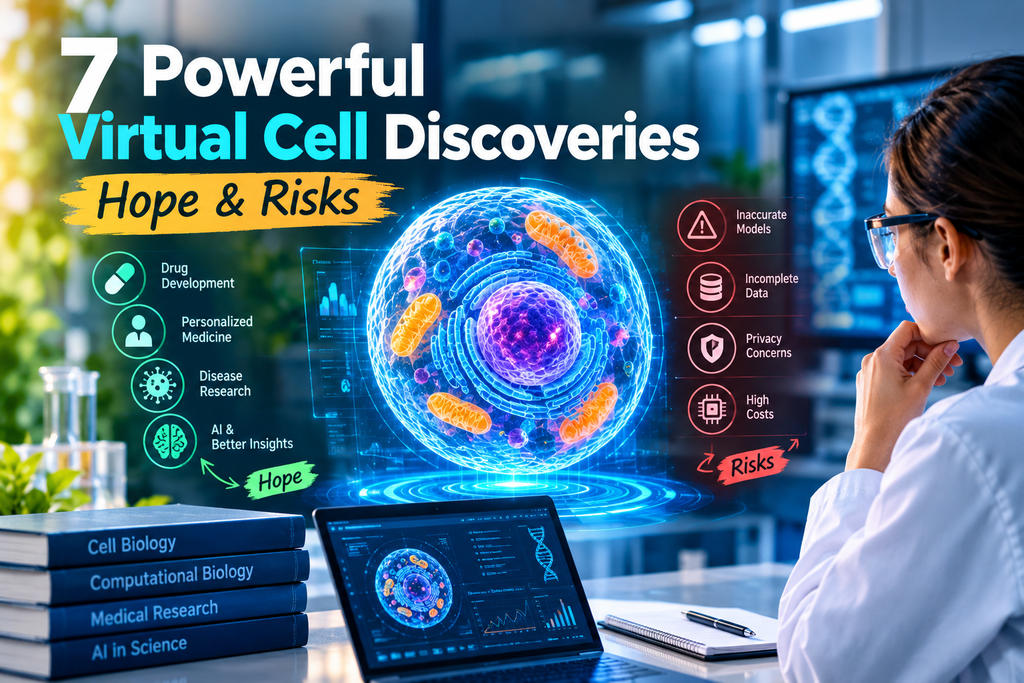
Nevertheless, these opportunities come with significant risks. A model may oversimplify living systems, rely on poor-quality data, or produce results that appear convincing without being biologically accurate. Researchers must also consider data privacy when patient-derived information is used to develop or evaluate models.
The following table summarizes the main opportunities and challenges.
| Research area | Potential benefit | Main limitation |
|---|---|---|
| Drug development | Helps prioritize experiments | Predictions need validation |
| Personalized medicine | Explores individual biological differences | Patient biology is highly complex |
| Disease research | Investigates cellular mechanisms | Models may omit important factors |
| AI-assisted biology | Finds patterns in large datasets | Biased data can affect predictions |
| Laboratory planning | Helps guide experiment design | Simulations cannot replace all experiments |
Virtual Cell Discoveries: A Simple Research Potential Graph
The following graph presents an illustrative comparison of how researchers might use virtual-cell approaches. The values are conceptual ratings from 1 to 5, not measured scientific results or proven performance statistics.
Illustrative potential across research applications
Drug research          █████  5
Disease modeling       █████  5
AI-assisted analysis   ████   4
Personalized medicine  ████   4
Clinical replacement   ██     2
This illustration highlights areas where virtual cells may support research while emphasizing that direct clinical replacement remains limited. Actual performance depends on the specific model, biological question, and quality of available evidence.
Future of Virtual Cell Discoveries
The future of Virtual Cell Discoveries may involve models that represent increasingly complex biological processes. Researchers are working toward integrating information about genes, proteins, cellular structures, and environmental conditions into more connected computational systems.
Better laboratory measurement techniques could provide more detailed information for building and testing these models. Advances in computing may also make complex simulations more practical for research institutions.
Another important direction is the development of models that can be updated as new experimental evidence becomes available. Such systems could help scientists compare predictions with observations and refine their understanding of cellular behavior over time.
However, progress will depend on collaboration between computational scientists, biologists, medical researchers, and data specialists. Reliable standards for testing, sharing, and evaluating models will be important for ensuring that results can be reproduced.
Scientific advances should also be communicated carefully. A promising simulation is not the same as a confirmed discovery, and a successful cellular prediction does not automatically demonstrate a safe or effective treatment in humans.
Conclusion: Virtual Cell Discoveries Offer Hope and Risks
Virtual Cell Discoveries represent a promising direction for modern biological research. By combining computational modeling, artificial intelligence, and experimental data, scientists can explore cellular processes, investigate diseases, and identify potential directions for drug development.
These technologies may help researchers use their time and resources more effectively while generating new questions about how living systems function. At the same time, incomplete data, model errors, privacy concerns, and limited biological complexity remain important challenges.
The most effective approach is to combine virtual simulations with carefully designed laboratory experiments and appropriate clinical research. With responsible development and continued validation, Virtual Cell Discoveries could become increasingly valuable tools for understanding biology and supporting future medical innovation.