Quantum Computing Discoveries are opening new possibilities for solving complex problems that traditional computers may struggle to handle. Researchers are exploring quantum processors, error correction, quantum algorithms, and new ways to simulate molecules and materials. These advances could eventually support drug research, chemistry, cybersecurity, and scientific discovery. However, Quantum Computing Discoveries also bring hidden risks, including technical limitations, high development costs, and potential threats to existing encryption systems. Understanding these developments helps readers separate genuine scientific progress from exaggerated claims about the future of quantum technology.
Table of Contents: Quantum Computing Discoveries
- Introduction to Quantum Computing Discoveries
- Quantum Computing Discoveries in Qubit Technology
- Quantum Computing Discoveries in Error Correction
- Quantum Computing Discoveries in Quantum Algorithms
- Quantum Computing Discoveries in Drug Research
- Quantum Computing Discoveries in Materials Science
- Quantum Computing Discoveries in Cryptography
- Quantum Computing Discoveries in Quantum Networking
- Quantum Computing Discoveries in Quantum Simulation
- Quantum Computing Discoveries: Hope and Hidden Risks
- Conclusion on Quantum Computing Discoveries
1. Introduction to Quantum Computing Discoveries
Quantum computing is a developing field that uses principles of quantum physics to process information. Traditional computers use bits that represent either zero or one. Quantum computers use quantum bits, commonly called qubits, which can be prepared in combinations of quantum states.
This difference allows quantum computers to approach certain calculations in ways that are fundamentally different from conventional computing. However, it does not mean quantum computers are automatically faster at every task. Their potential advantages depend on the problem, the algorithm, and the quality of the quantum hardware.
Many important Quantum Computing Discoveries are focused on making quantum systems more reliable. Scientists are investigating how to control qubits, reduce errors, and connect quantum operations into useful calculations. These improvements are essential because quantum states are delicate and can be disturbed by unwanted interactions with their surroundings.
2. Quantum Computing Discoveries in Qubit Technology
Qubits are the foundation of quantum computing. Researchers are exploring several approaches to building them, including superconducting circuits, trapped ions, neutral atoms, and photonic systems. Each approach has different strengths and engineering challenges.
Superconducting qubits can be controlled using microwave signals and fabricated using techniques related to modern electronics. Trapped-ion systems use electrically charged atoms controlled by electromagnetic fields and lasers. Neutral-atom systems use individual atoms arranged and manipulated with carefully controlled laser light, while photonic approaches use particles of light to carry quantum information.
Quantum Computing Discoveries in More Reliable Qubits
One major research goal is to create qubits that remain stable long enough to perform useful operations. Researchers also need to control qubits accurately and connect them in ways that support complex calculations.
A system with many physical qubits is not necessarily more powerful than a smaller, better-controlled system. The quality of operations, connectivity, error rates, and ability to correct mistakes all influence performance.
These Quantum Computing Discoveries are important because future quantum computers will need more than a large number of qubits. They will require reliable components that can work together consistently.
3. Quantum Computing Discoveries in Quantum Error Correction
Quantum information is vulnerable to noise. Small disturbances can introduce errors, and those errors may ruin the results of a calculation. This is one of the biggest obstacles facing practical quantum computing.
Quantum error correction addresses this challenge by distributing quantum information across multiple physical qubits. Researchers use additional qubits and carefully designed measurements to detect error patterns without directly measuring and destroying the encoded quantum information.
Quantum Computing Discoveries in Logical Qubits
A logical qubit is an encoded unit of quantum information designed to be more reliable than its individual physical components. Depending on the system and error-correction method, multiple physical qubits may be needed to protect one logical qubit.
Researchers have demonstrated important steps toward error correction, including experiments in which encoded quantum information becomes more reliable as protection improves. However, building a large, fault-tolerant quantum computer remains a substantial engineering challenge.
The goal is to perform long calculations while keeping errors sufficiently low. Achieving this could allow quantum computers to tackle problems that are impractical for current quantum hardware.
4. Quantum Computing Discoveries in Quantum Algorithms
Quantum algorithms are procedures designed to use quantum operations to solve specific computational problems. Some theoretical algorithms offer important advantages over known classical approaches for particular tasks.
Shor’s algorithm, for example, provides a theoretical method for factoring large integers efficiently on a sufficiently powerful fault-tolerant quantum computer. Grover’s algorithm can provide a quadratic speedup for certain unstructured search problems compared with standard classical search methods.
Quantum Computing Discoveries in Practical Algorithms
An algorithm that works mathematically is not necessarily ready for immediate practical use. Some require large numbers of reliable qubits and many precise operations. Today’s quantum hardware often struggles with the depth and error rates needed for demanding applications.
Researchers are also investigating hybrid quantum-classical methods, where a quantum processor performs part of a calculation and a conventional computer handles other tasks. These methods are being explored in optimization, chemistry, and machine learning.
The important question is whether a quantum approach can outperform the best available classical methods on a useful real-world task. Strong evidence requires fair comparisons, reproducible experiments, and clear measurements of computational costs.
5. Quantum Computing Discoveries in Drug Research
Drug development involves understanding how molecules interact, how chemical structures influence biological activity, and how potential treatments behave in complex systems. Quantum computing could eventually help researchers model some molecular processes more naturally than conventional approximations.
Quantum systems follow the laws of quantum mechanics, which also govern the behavior of electrons and chemical bonds. This makes quantum simulation an attractive long-term application for chemistry and materials research.
Quantum Computing Discoveries in Molecular Simulation
Scientists are studying algorithms that could calculate molecular energy levels and other chemical properties. Such calculations may help researchers understand reaction mechanisms or evaluate the behavior of complex molecules.
However, current quantum computers have limited capabilities, and many useful chemical calculations can already be performed with classical computing methods. A quantum approach must demonstrate meaningful improvements in accuracy, speed, or resource requirements before it can transform routine drug development.
Quantum computers will not independently discover safe medicines without laboratory work. Experimental validation, biological studies, clinical trials, and regulatory review will remain essential.
6. Quantum Computing Discoveries in Materials Science
Materials science is another promising area for quantum computing. Researchers want to understand how atoms and electrons interact in materials used for batteries, electronics, solar cells, and industrial processes.
These interactions can be difficult to simulate accurately because quantum systems may involve many particles whose behaviors are interconnected. Quantum computers could eventually help scientists model selected systems that challenge conventional computational approaches.
Quantum Computing Discoveries for Better Materials
Potential applications include investigating superconductors, catalysts, magnetic materials, and chemical reactions. Better simulations might help researchers narrow the list of materials worth synthesizing and testing in laboratories.
For example, battery researchers need to understand how materials behave during charging, discharging, and chemical changes. Quantum calculations could contribute to this work if suitable algorithms and hardware become available.
Nevertheless, there is no guarantee that quantum computing will quickly produce better batteries or cheaper industrial materials. Material performance also depends on manufacturing, durability, cost, and real-world operating conditions. Laboratory testing will remain central to confirming any discovery.
7. Quantum Computing Discoveries in Cryptography
Quantum computing has important implications for digital security. Many existing public-key cryptographic systems rely on mathematical problems that are difficult for conventional computers to solve efficiently.
A sufficiently powerful, fault-tolerant quantum computer running Shor’s algorithm could threaten widely used public-key systems based on integer factorization or discrete logarithms. This includes RSA and elliptic-curve cryptography.
Quantum Computing Discoveries and Encryption Risks
This threat is serious, but it does not mean today’s quantum computers can immediately break all modern encryption. Current machines do not have the demonstrated fault-tolerant scale required to carry out the most demanding attacks on widely used cryptographic keys.
Researchers and security organizations are preparing through post-quantum cryptography. These methods are designed to resist known attacks from both conventional and quantum computers.
Organizations should assess which systems rely on vulnerable cryptography and plan how to replace or update those systems. This preparation matters because sensitive information captured today could potentially be decrypted in the future if it remains valuable and a capable attacker eventually obtains suitable quantum technology.
8. Quantum Computing Discoveries in Quantum Networking
Quantum networking explores how quantum information can be distributed between different locations. Researchers are investigating quantum communication links, entanglement distribution, quantum memories, and devices that may help connect separate quantum processors.
Entanglement is a quantum phenomenon in which connected systems exhibit correlations that cannot be explained by ordinary classical models. It is a key resource in several quantum information protocols.
Quantum Computing Discoveries in Secure Communication
Quantum communication research includes quantum key distribution, which can allow communicating parties to detect certain kinds of eavesdropping under appropriate conditions. Such systems depend on specialized equipment, secure implementation, and trusted operating procedures.
A quantum network is not simply a faster version of the internet. It would support different capabilities and would face engineering challenges involving signal loss, quantum memories, network components, and reliable distribution of entanglement.
Researchers are working toward systems that can connect quantum devices over greater distances. Practical, large-scale quantum networks remain an active research goal rather than a universal replacement for conventional communications.
9. Quantum Computing Discoveries in Quantum Simulation
Quantum simulation uses controllable quantum systems to investigate the behavior of other quantum systems. It is one of the most natural potential applications because both the computer and the simulated subject follow quantum principles.
Researchers can use quantum devices to study simplified models of magnetism, particle interactions, and other physical phenomena. Some experiments use specialized quantum simulators rather than fully programmable, general-purpose quantum computers.
Quantum Computing Discoveries in Physics Research
These experiments can help scientists explore questions about how quantum materials behave and how complex physical systems evolve. They may reveal patterns that are difficult to investigate using analytical mathematics or conventional simulation alone.
However, simulation results must be interpreted carefully. Scientists need to validate experimental controls, estimate uncertainties, and compare results with established theories or other computational approaches whenever possible.
Quantum simulation is promising because it may help researchers investigate physical processes that are expensive to model classically. Its ultimate value will depend on the complexity of the systems that can be simulated reliably and the new scientific knowledge those simulations provide.
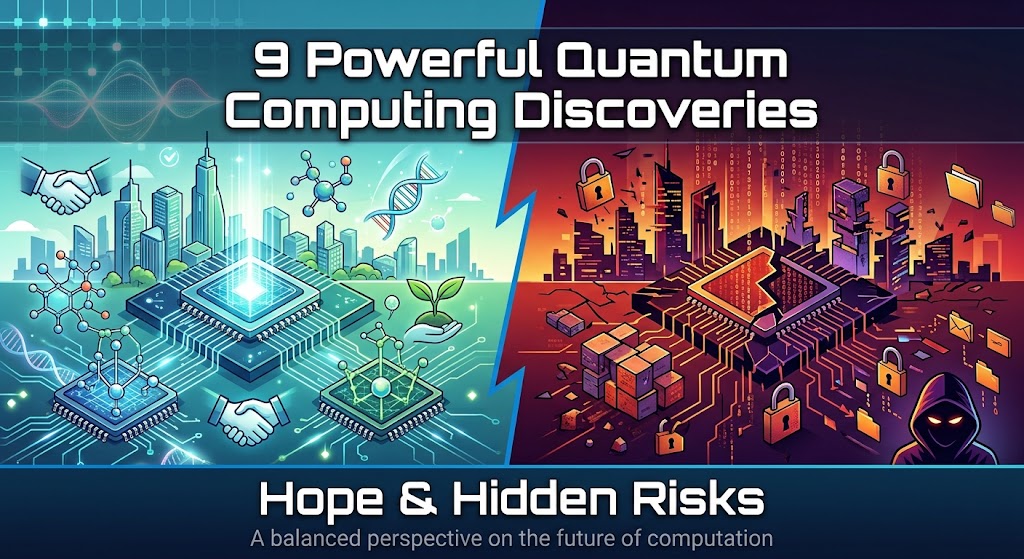
10. Quantum Computing Discoveries: Hope and Hidden Risks
Quantum computing could eventually expand scientific capabilities, but several barriers remain. Hardware is expensive, quantum states are sensitive to noise, and reliable error correction requires substantial resources. There is also uncertainty about when particular commercial applications will become practical.
Quantum Computing Discoveries and Future Opportunities
The potential benefits include more advanced molecular simulations, improved understanding of selected materials, and new computational approaches for specific mathematical problems. Quantum technology may also contribute to specialized sensing and communication systems.
These opportunities should be assessed individually. A successful laboratory demonstration does not automatically establish a commercial advantage, and a theoretical speedup does not guarantee lower costs for real-world applications.
Quantum Computing Discoveries and Hidden Risks
Security is one of the clearest concerns because sufficiently capable quantum computers could threaten some existing public-key cryptography. Another challenge is unequal access: specialized hardware, expert staff, and research infrastructure may remain concentrated in a small number of organizations.
Environmental costs also deserve attention. Quantum processors require specialized equipment and carefully controlled operating environments, and the overall energy and resource requirements depend on the technology used.
Responsible development requires transparent reporting, realistic performance claims, strong cybersecurity planning, and continued scientific testing. Public understanding is important too, because exaggerated claims can create confusion about what quantum computers can achieve today.
11. Conclusion on Quantum Computing Discoveries
Quantum Computing Discoveries are advancing the study of qubits, error correction, quantum algorithms, molecular simulation, materials science, cryptography, and quantum communication. These developments could eventually support important scientific and technological breakthroughs.
However, the technology is still developing, and practical advantages will depend on reliable hardware, efficient algorithms, and evidence from real applications. Quantum computing will not replace conventional computers for every task, nor will every research result become a commercial product.
The most promising future is one in which scientists continue testing bold ideas while addressing security, reliability, cost, and accessibility. By understanding both the opportunities and the limitations, readers can follow Quantum Computing Discoveries with informed expectations and a clearer view of what may come next.