PFAS Removal Technologies are becoming increasingly important as scientists, water treatment experts, and environmental researchers search for effective ways to reduce persistent chemicals in drinking water and contaminated environments. PFAS, commonly known as per- and polyfluoroalkyl substances, are a large group of synthetic chemicals used in products such as nonstick cookware, stain-resistant fabrics, and certain industrial materials. Because many PFAS break down very slowly, they can remain in the environment for long periods. Modern PFAS Removal Technologies offer hope for cleaner water and reduced exposure, but challenges involving cost, waste disposal, energy use, and complete chemical destruction remain. Understanding these technologies can help communities recognize both their potential benefits and their limitations.
Table of Contents: PFAS Removal Technologies
- Introduction to PFAS Removal Technologies
- PFAS Removal Technologies Using Activated Carbon
- PFAS Removal Technologies Using Ion Exchange Resins
- PFAS Removal Technologies Using Reverse Osmosis
- PFAS Removal Technologies Using Nanofiltration
- PFAS Removal Technologies Using Electrochemical Treatment
- PFAS Removal Technologies Using Plasma Technology
- PFAS Removal Technologies Using Advanced Oxidation and Heat
- PFAS Removal Technologies: Hope and Hidden Risks
- Conclusion on PFAS Removal Technologies
1. Introduction to PFAS Removal Technologies
PFAS are widely studied because their chemical structures can make many of them resistant to natural degradation. Some PFAS have been detected in groundwater, rivers, soil, and drinking water sources. Exposure to certain PFAS has been associated with health concerns, although risks vary by chemical, exposure level, and individual circumstances.
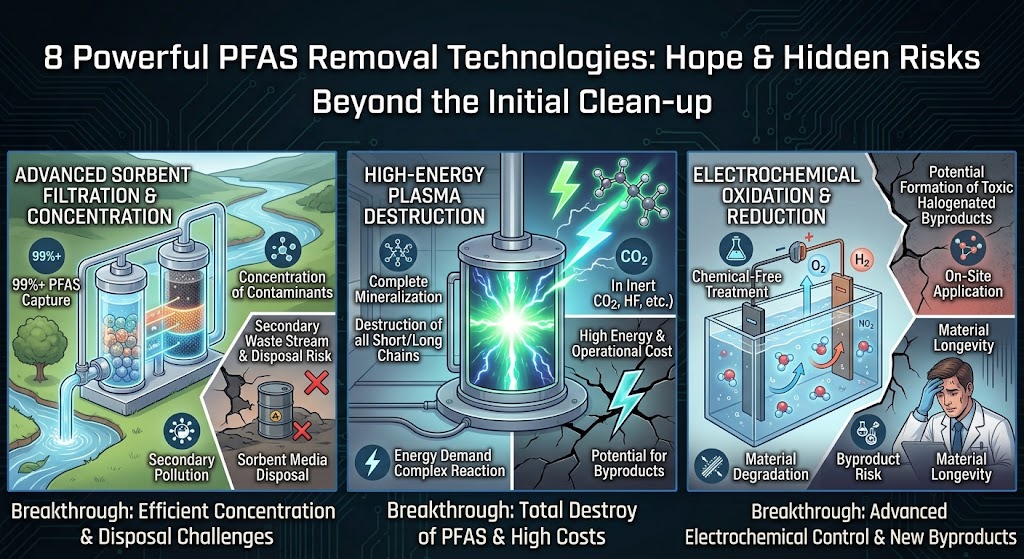
Removing PFAS from water is challenging because these substances can occur at very low concentrations. Different PFAS also behave differently depending on their molecular size, electrical charge, and chemical structure.
Scientists have developed several treatment approaches to address these problems. Some technologies capture PFAS and separate them from water, while others aim to break down the chemicals themselves. This distinction is important because removing PFAS from water does not necessarily destroy them.
The most suitable treatment depends on the type of PFAS present, the amount of water being treated, local water chemistry, treatment costs, and how the resulting waste will be managed.
2. PFAS Removal Technologies Using Activated Carbon
Activated carbon is one of the established approaches used to reduce certain PFAS in contaminated water. It contains a highly porous structure with a large internal surface area, allowing chemicals to attach to its surface through a process called adsorption.
Granular activated carbon is commonly used in water treatment systems. Water passes through a bed of carbon, where some PFAS are retained while treated water continues through the system.
PFAS Removal Technologies and Carbon Filtration
Activated carbon can be effective for many longer-chain PFAS, including certain compounds that have been widely monitored in drinking water. However, its performance depends on the specific chemical, carbon characteristics, competing substances, and operating conditions.
Some shorter-chain PFAS can pass through carbon filters more readily than longer-chain compounds. As a result, treatment systems need appropriate design, monitoring, and timely replacement or regeneration of the carbon.
Used carbon also requires careful management. PFAS captured on the material do not automatically disappear. Depending on the treatment facility and applicable regulations, the carbon may be regenerated, treated, or disposed of through an appropriate waste-management process.
Despite these challenges, activated carbon remains an important option because it can be integrated into established water treatment infrastructure.
3. PFAS Removal Technologies Using Ion Exchange Resins
Ion exchange resins are specially designed materials that can capture certain charged contaminants from water. Some resins have been developed to remove PFAS more efficiently than conventional filtration media under suitable conditions.
Water flows through a container filled with resin beads. The material interacts with PFAS and retains them, reducing their concentration in the water leaving the treatment unit.
PFAS Removal Technologies and Selective Resins
Certain anion exchange resins are particularly useful for capturing negatively charged PFAS. Their effectiveness depends on resin chemistry, water composition, and the particular PFAS being targeted.
In some applications, ion exchange can provide high removal performance and may require a smaller treatment footprint than some alternative systems. It can also be combined with activated carbon or other treatment methods.
However, other dissolved substances can compete for binding sites. Resin performance may decline as the material becomes saturated, making monitoring and replacement essential.
Spent resin can contain concentrated PFAS and therefore requires careful handling. Regeneration may produce a concentrated waste stream that still needs further treatment. The resin itself does not necessarily destroy the chemicals it captures.
Ion exchange is promising for appropriately designed systems, but its overall environmental value depends on both water treatment performance and safe management of the resulting waste.
4. PFAS Removal Technologies Using Reverse Osmosis
Reverse osmosis uses a semipermeable membrane and applied pressure to separate many dissolved substances from water. It is already used in applications such as desalination and drinking water purification.
When water is forced through a suitable membrane, many PFAS molecules are retained in a concentrated stream, while the treated water passes through.
PFAS Removal Technologies and Membrane Filtration
Reverse osmosis can achieve high removal of many PFAS under appropriate operating conditions. Its performance depends on the membrane, the chemical properties of the PFAS, and the quality of the incoming water.
One important advantage is that reverse osmosis can remove a broad range of dissolved contaminants, not only PFAS. This may be useful where several water-quality problems occur together.
However, reverse osmosis has important limitations. It consumes energy to pressurize water, requires maintenance, and produces a concentrated reject stream containing PFAS and other substances.
That concentrated waste must be managed safely. If it is discharged without suitable treatment, PFAS can simply move from one part of the water system into another.
Membrane treatment therefore needs a complete waste-management strategy. High removal from the treated water is valuable, but it does not mean the captured chemicals have been destroyed.
5. PFAS Removal Technologies Using Nanofiltration
Nanofiltration is another membrane-based process that can help reduce PFAS in water. Its separation characteristics differ from those of reverse osmosis, and its performance varies depending on membrane design and water chemistry.
Nanofiltration membranes can retain many dissolved substances based on molecular size, charge, and interactions with the membrane. Certain systems can remove selected PFAS while allowing some smaller dissolved components to pass through.
PFAS Removal Technologies for Efficient Water Treatment
Researchers are investigating how nanofiltration can balance contaminant removal, energy consumption, and water recovery. In suitable applications, it may provide an alternative to reverse osmosis when the overall treatment requirements permit.
Nevertheless, nanofiltration does not perform identically for every PFAS. Some compounds may be retained more effectively than others, and dissolved salts or organic matter can affect performance.
Like reverse osmosis, nanofiltration generates a concentrated stream that requires proper management. Membrane fouling can also reduce efficiency and increase maintenance needs.
The technology may become more useful as membrane materials improve, but decisions should be based on independent testing and the specific contamination problem rather than broad claims that one membrane can remove every PFAS.
6. PFAS Removal Technologies Using Electrochemical Treatment
Electrochemical treatment is an emerging area of PFAS research. These systems use electrical energy and specially designed electrodes to encourage chemical reactions that may transform or break down selected PFAS.
Unlike conventional filtration, which primarily separates contaminants from water, some electrochemical approaches aim to destroy them.
PFAS Removal Technologies and Chemical Breakdown
Researchers are investigating electrode materials, electrical conditions, and reactor designs that can improve the degradation of persistent chemicals. Certain laboratory studies have demonstrated that electrochemical processes can break down some PFAS under controlled conditions.
However, performance varies considerably by compound and treatment conditions. Some PFAS are more resistant than others, and incomplete treatment may leave intermediate products or residual contamination.
Energy consumption, electrode durability, water composition, and treatment costs are also important considerations. A system that works well with a small laboratory sample may not be equally effective at a large water treatment facility.
Before electrochemical technologies can be widely adopted, researchers need reliable evidence about destruction efficiency, unwanted byproducts, operating costs, and long-term performance.
These technologies offer an important research direction because they seek to address the underlying chemical persistence of PFAS rather than simply transferring the contaminants into another material.
7. PFAS Removal Technologies Using Plasma Technology
Plasma-based treatment is another developing approach that scientists are investigating for PFAS destruction. Plasma contains energetic particles and reactive species that can initiate chemical reactions under suitable conditions.
Some experimental systems use plasma in or above contaminated water to target certain persistent compounds. Researchers are studying how these systems interact with PFAS and whether they can break down contaminants efficiently.
PFAS Removal Technologies and Reactive Plasma
Laboratory studies have shown that some plasma processes can degrade selected PFAS. The results depend on reactor design, water conditions, chemical structure, treatment duration, and energy input.
One area of interest is whether plasma treatment can reduce PFAS concentrations in contaminated liquid waste streams. These streams may be generated by other treatment technologies, including processes that concentrate PFAS from larger volumes of water.
However, plasma treatment remains a developing field, and results from controlled experiments should not automatically be interpreted as proof of widespread commercial readiness.
Scientists must measure not only the disappearance of the original PFAS but also the formation of transformation products and, where possible, the extent of mineralization into simpler substances.
Energy efficiency, equipment costs, operational complexity, and scale-up remain important challenges. Plasma technology offers hope, but more testing is needed to establish where it can provide a practical advantage over existing treatment methods.
8. PFAS Removal Technologies Using Advanced Oxidation and Heat
Advanced oxidation processes use highly reactive chemical species to transform certain contaminants. Heat-based methods, including specialized thermal treatment, can also be investigated for managing PFAS-containing materials or concentrated waste.
These approaches are not interchangeable, and their effectiveness depends on the specific process and PFAS involved.
PFAS Removal Technologies and Advanced Oxidation
Conventional advanced oxidation methods can be useful for many organic pollutants, but PFAS are unusually resistant to several common oxidation treatments. Standard approaches that work well for other contaminants may perform poorly against certain PFAS.
Researchers are therefore exploring specialized combinations of reactive chemicals, catalysts, ultraviolet light, and other treatment conditions. The goal is to identify methods that can transform persistent compounds without creating unacceptable byproducts.
Thermal treatment is also being studied and used in particular waste-management settings. Properly designed and operated systems may destroy certain PFAS-containing wastes, but temperature alone does not guarantee complete destruction under every condition.
Treatment systems require appropriate monitoring, emissions controls, and verification that the process achieves its intended result. Inadequate treatment could leave residual PFAS or create other environmental concerns.
These approaches illustrate why PFAS treatment requires chemistry-specific testing rather than assuming that one general-purpose method will work for every contaminant.
9. PFAS Removal Technologies: Hope and Hidden Risks
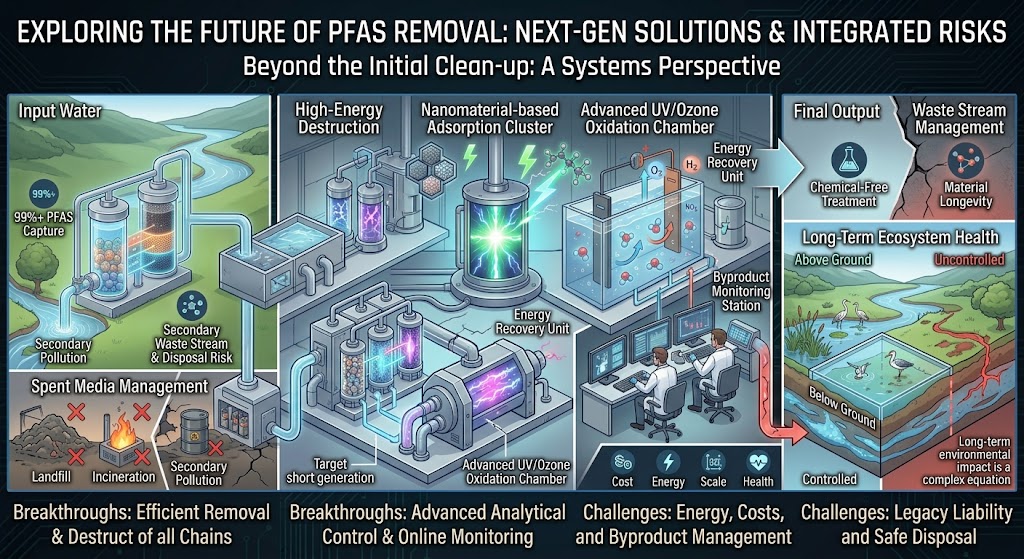
PFAS treatment is not a single-step problem. Different technologies can perform different roles, and some facilities may need multiple processes to meet water-quality goals.
PFAS Removal Technologies and Their Main Benefits
Activated carbon, ion exchange, reverse osmosis, and nanofiltration can reduce PFAS concentrations in treated water when correctly selected and operated. These methods can help protect drinking water supplies and manage contamination in suitable applications.
Electrochemical treatment, plasma technology, and specialized destruction processes may help address concentrated PFAS waste or other difficult treatment streams. Continued research could improve efficiency and reduce the cost of handling persistent chemicals.
PFAS Removal Technologies and Hidden Risks
The biggest concern is confusing removal with destruction. A filter can produce cleaner water while leaving PFAS concentrated in spent carbon, resin, or reject water. That residual material must still be managed to prevent contamination from returning to the environment.
Other challenges include energy consumption, treatment expenses, equipment maintenance, and differences in performance across PFAS compounds. Poorly designed systems may also create byproducts or fail to meet the required water-quality standards.
Successful PFAS treatment requires testing the incoming water, selecting a suitable technology, monitoring treated water, and developing a safe plan for waste handling. Independent verification is particularly important when a supplier claims that a system eliminates all PFAS.
The long-term goal is to combine effective contaminant removal, verified destruction where feasible, and responsible waste management. This approach offers a more complete solution than relying on filtration alone.
10. Conclusion on PFAS Removal Technologies
PFAS Removal Technologies are advancing efforts to reduce persistent chemical contamination in water and manage PFAS-containing waste. Activated carbon and ion exchange are established options, while reverse osmosis and nanofiltration can provide effective separation under suitable conditions. Electrochemical treatment, plasma processes, and specialized destruction methods offer additional possibilities that researchers continue to evaluate.
Nevertheless, no single treatment method is ideal for every PFAS or every contaminated site. Performance, costs, energy use, and waste disposal all influence the overall outcome.
The most promising future will combine reliable testing, suitable treatment systems, careful waste management, and continued scientific research. By distinguishing between capturing PFAS and actually destroying them, communities and water providers can make better-informed decisions and work toward cleaner water with fewer environmental risks.