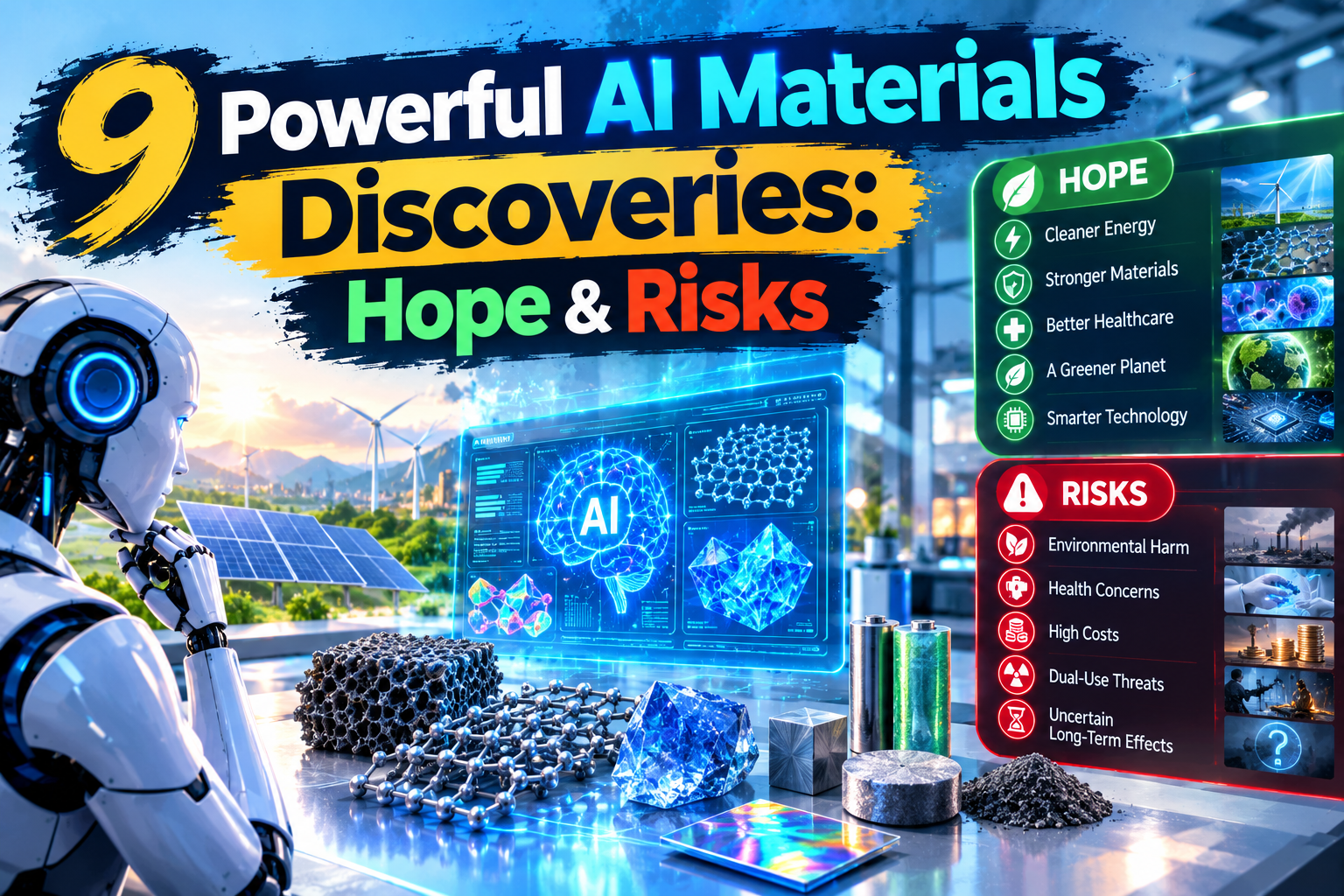
Introduction to AI Materials Discoveries
AI Materials Discoveries are transforming how scientists search for new substances, predict material properties, and develop technologies for energy, electronics, manufacturing, and medicine. Instead of relying entirely on traditional trial-and-error experiments, researchers can use artificial intelligence (AI) to analyze scientific databases, generate possible material structures, and identify promising candidates for further testing. Research published in 2026 highlights advances in generative AI, machine learning, materials prediction, and automated laboratory workflows. However, computer-generated materials are not automatically practical or safe. Their real value depends on whether scientists can produce them, verify their properties, and manufacture them reliably 9 Powerful AI Materials Discoveries: Hope & Risks.
Table of Contents: AI Materials Discoveries
- What Are AI Materials Discoveries?
- How AI Materials Discoveries Work
- Nine Powerful AI Materials Discoveries
- Benefits of AI Materials Discoveries
- Hidden Risks of AI Materials Discoveries
- Research Comparison Table
- The Future of AI Materials Discoveries
- Frequently Asked Questions
- Conclusion
What Are AI Materials Discoveries?
AI materials discovery is the use of artificial intelligence and computational science to identify, design, or improve materials with useful properties. These properties might include strength, flexibility, electrical conductivity, heat resistance, chemical stability, or the ability to store energy 9 Powerful AI Materials Discoveries: Hope & Risks.

Picture 1: AI-Designed Materials
Traditional materials research often involves selecting a composition, producing a sample, measuring its properties, and adjusting the design. This process remains essential, but it can require considerable time and resources. AI can help researchers narrow the search space before conducting physical experiments.
A model may learn relationships between a material’s composition, atomic structure, and measured performance. Other models can generate candidate structures that aim to meet specific requirements. The predictions help researchers decide which candidates deserve closer examination 9 Powerful AI Materials Discoveries: Hope & Risks.
A major distinction is that discovering a possible material computationally is not the same as producing a useful material in the real world. Successful development requires synthesis, testing, stability analysis, and sometimes years of engineering work.
How AI Materials Discoveries Work
AI-driven materials research generally combines data, algorithms, computational predictions, and experimental validation.
Machine Learning for AI Materials Discoveries
Machine learning models learn patterns from existing materials data. Researchers can use these patterns to estimate properties such as stability, conductivity, or mechanical performance. Prediction quality depends on the data, the model, and how closely a new candidate resembles the materials used during training 9 Powerful AI Materials Discoveries: Hope & Risks.
Generative Models for AI Materials Discoveries

Picture 2: Materials Testing
Generative AI approaches can propose new chemical compositions or atomic arrangements. Instead of only ranking existing candidates, these models attempt to create designs that match a target property. Researchers must still determine whether the proposed structures are physically plausible and experimentally achievable.
Automated Testing for AI Materials Discoveries
Some research workflows connect AI predictions with laboratory automation. Instruments and robotic systems can prepare samples, conduct measurements, and return experimental data to the model. This creates a feedback loop in which future predictions can improve through testing 9 Powerful AI Materials Discoveries: Hope & Risks.
Nine Powerful AI Materials Discoveries
1. AI Materials Discoveries for Faster Candidate Screening
One important application is screening large collections of potential materials. Researchers can use computational models to estimate which candidates deserve more detailed calculations or physical experiments 9 Powerful AI Materials Discoveries: Hope & Risks.
This is particularly valuable when many possible combinations of elements and structures exist. AI-assisted screening can help scientists prioritize candidates rather than testing every possibility individually. Nevertheless, screening results are only as reliable as the underlying data and validation methods.
2. AI Materials Discoveries for Better Batteries
Battery research requires materials that balance energy storage, charging performance, safety, durability, and cost. AI can help researchers investigate electrode materials, electrolytes, and interfaces that influence battery performance. 9 Powerful AI Materials Discoveries: Hope & Risks.
Models may identify promising compositions or predict how changes in structure affect important properties. These predictions could help guide research into batteries for electric vehicles and grid storage.
However, a promising computational result does not prove that a battery will charge faster or last longer. Researchers must evaluate real cells, temperature effects, degradation, manufacturing costs, and safety before drawing practical conclusions 9 Powerful AI Materials Discoveries: Hope & Risks.
3. AI Materials Discoveries for Advanced Semiconductors
Semiconductors are essential for computers, sensors, communications equipment, and AI hardware. Researchers are exploring ways to identify materials with useful electrical, optical, and thermal properties.
AI models can help compare candidate compounds and investigate relationships between atomic structure and performance. Better candidate selection may support future research into energy-efficient electronics and specialized semiconductor devices 9 Powerful AI Materials Discoveries: Hope & Risks.
The challenge is that electronic materials must meet demanding requirements simultaneously. A candidate with excellent theoretical properties may still be difficult to manufacture or integrate into a working device.
4. AI Materials Discoveries for Cleaner Energy
Clean energy technologies rely on materials for solar cells, fuel cells, catalysts, and energy storage. AI can assist researchers in searching for substances that absorb light efficiently, improve chemical reactions, or remain stable under demanding operating conditions.
For example, models can prioritize catalyst candidates for further testing. Experimental research can then determine whether the materials work under real operating conditions and whether their ingredients are affordable and accessible.
AI therefore offers a way to guide energy research, but it cannot guarantee cheaper electricity or immediate commercial breakthroughs 9 Powerful AI Materials Discoveries: Hope & Risks.
5. AI Materials Discoveries for Stronger and Lighter Materials
The aerospace, automotive, and construction industries need materials that combine strength, low weight, durability, and affordability. AI can help explore alloys, composites, ceramics, and other material families.
By learning from existing measurements, models may identify combinations worth testing for particular applications. Such work could support research into lighter vehicles, durable components, and improved industrial equipment 9 Powerful AI Materials Discoveries: Hope & Risks.
Still, strength is only one part of material performance. Fatigue, corrosion, temperature resistance, repairability, and long-term reliability also matter when deciding whether a material is suitable for real-world use.
6. AI Materials Discoveries for Better Catalysts
Catalysts help chemical reactions occur more efficiently without being consumed in the overall reaction. They are important in chemical manufacturing, pollution control, and several clean-energy processes.
AI can help investigate the relationship between a catalyst’s atomic structure and its activity. Researchers can use these predictions to prioritize materials that may improve reaction efficiency or reduce dependence on expensive elements.
The major challenge is determining whether a candidate remains effective over time. Laboratory measurements must examine reaction conditions, durability, selectivity, and production costs.
7. AI Materials Discoveries Through Inverse Design
Inverse design starts with a desired outcome and searches for a material that might achieve it. For example, a researcher may want a substance with a particular combination of conductivity, flexibility, and thermal stability.
Generative models can propose structures that fit the specified requirements. This approach differs from simply predicting the properties of materials that already exist.
Research reviews published in 2026 discuss inverse design as an important direction in AI-driven materials science. Even so, generated candidates need physical and chemical checks before scientists can establish their feasibility.
8. AI Materials Discoveries Through Self-Driving Laboratories
Self-driving laboratories combine computational models, automated equipment, and experimental feedback. An AI system may suggest an experiment, laboratory instruments perform it, and the resulting measurements inform the next decision 9 Powerful AI Materials Discoveries: Hope & Risks.
This approach can reduce repetitive manual work and help researchers explore promising experimental conditions systematically. It may be especially useful when experiments involve many possible combinations or require repeated optimization.
However, automation does not remove the need for careful experimental design. Poor measurements, equipment errors, or biased data can still produce misleading results.
9. AI Materials Discoveries for Sustainable Manufacturing
Sustainable manufacturing requires materials that perform well while reducing waste, energy consumption, and environmental damage. AI may help researchers compare alternative compositions and identify candidates that use more abundant ingredients or require less energy to process 9 Powerful AI Materials Discoveries: Hope & Risks.
Models can also help investigate recyclable materials, durable coatings, and alternatives to substances with environmental concerns.
Sustainability must be assessed across the material’s life cycle. A material that performs well in one test may still require energy-intensive production, difficult disposal, or scarce raw materials. Environmental benefits need evidence rather than assumptions.
Benefits of AI Materials Discoveries
AI-assisted research can help scientists organize large datasets, compare potential candidates, and prioritize experiments. These capabilities may reduce unnecessary testing and direct laboratory resources toward more promising questions 9 Powerful AI Materials Discoveries: Hope & Risks.
Another benefit is the ability to investigate complex relationships between a material’s structure and properties. Researchers can use models to generate hypotheses that might not be obvious from a small set of experiments.
AI may also support collaboration between chemists, physicists, materials engineers, and computer scientists. Shared datasets and computational tools can help teams compare results and build on earlier findings.
The strongest benefit is not that AI replaces scientists. It is that AI can help scientists make better-informed decisions about what to investigate next.
Hidden Risks of AI Materials Discoveries
One major risk is poor data quality. Materials databases can contain incomplete measurements, inconsistent terminology, or results collected under different experimental conditions. A model trained on such data may make unreliable predictions 9 Powerful AI Materials Discoveries: Hope & Risks.
Another problem is the gap between theoretical and practical performance. A computational model may suggest a stable structure, but producing it in a laboratory could be difficult or expensive. Predicted stability may also differ from behavior under heat, pressure, moisture, or chemical exposure.
AI models can also produce biased results if their training data underrepresent certain materials or experimental settings. Researchers should report uncertainty, test models on independent data, and compare predictions with physical measurements 9 Powerful AI Materials Discoveries: Hope & Risks.
Finally, commercialization introduces questions about resource availability, manufacturing scale, environmental impact, and safety. These issues are especially important for materials intended for batteries, electronics, medical devices, or industrial infrastructure.
Research Comparison Table: AI Materials Discoveries
| Application | Potential opportunity | Main challenge |
|---|---|---|
| Battery materials | Improve candidate selection | Safety and durability |
| Semiconductors | Explore useful electronic properties | Manufacturing complexity |
| Solar materials | Investigate light-conversion performance | Stability and lifetime |
| Catalysts | Search for efficient reactions | Real-world validation |
| Lightweight alloys | Balance strength and weight | Fatigue and corrosion |
| Inverse design | Generate target-oriented candidates | Physical feasibility |
| Automated laboratories | Improve experimental workflows | Equipment reliability |
| Sustainable materials | Explore lower-impact alternatives | Life-cycle assessment |
| Material screening | Prioritize large candidate sets | Data quality and bias |
The Future of AI Materials Discoveries
The future of AI materials discoveries will depend on combining better models with reliable datasets, scientific knowledge, and automated experiments. Researchers are increasingly interested in workflows that connect candidate generation, property prediction, synthesis planning, and experimental verification 9 Powerful AI Materials Discoveries: Hope & Risks.
Another important direction is explainable AI. Scientists need to understand why a model recommends a particular material, which evidence supports the prediction, and how uncertain the result may be. This is especially important when materials will be used in safety-critical applications 9 Powerful AI Materials Discoveries: Hope & Risks.
Open research databases and reproducible testing may also help different research teams compare results. Over time, these improvements could make AI-assisted discovery more dependable across batteries, electronics, catalysts, and other material categories.
However, progress will not be measured simply by how many candidates an algorithm generates. More meaningful measures include experimentally verified performance, reproducibility, manufacturing feasibility, cost, and environmental impact 9 Powerful AI Materials Discoveries: Hope & Risks.
Frequently Asked Questions About AI Materials Discoveries
What are AI Materials Discoveries?
AI materials discoveries use artificial intelligence and computational methods to identify, design, or improve materials with desired properties.
Can AI invent new materials?
AI can generate candidate compositions and structures that researchers may not have considered. Scientists must still determine whether those candidates are physically plausible and can be produced.
Are AI Materials Discoveries useful for batteries?
Yes. AI can help screen battery materials and investigate potential improvements, but real battery testing is necessary to establish safety, performance, and durability 9 Powerful AI Materials Discoveries: Hope & Risks.
What are the main risks of AI materials research?
Important risks include unreliable data, inaccurate predictions, limited explainability, manufacturing difficulties, and environmental trade-offs.
Will AI replace materials scientists?
AI is more likely to serve as a research tool that supports human expertise. Scientists remain essential for experiment design, validation, interpretation, and safety decisions.
Conclusion: Why AI Materials Discoveries Matter
AI materials discoveries offer a promising way to explore new substances and improve existing materials. From battery research and semiconductors to catalysts and sustainable manufacturing, AI can help scientists screen candidates, generate designs, and plan experiments more efficiently 9 Powerful AI Materials Discoveries: Hope & Risks.
Nevertheless, predictions must not be confused with proven breakthroughs. Experimental validation, reproducibility, affordability, and environmental assessment remain essential. By combining AI with careful scientific testing, researchers can turn promising computational ideas into materials that may eventually provide real-world benefits 9 Powerful AI Materials Discoveries: Hope & Risks.