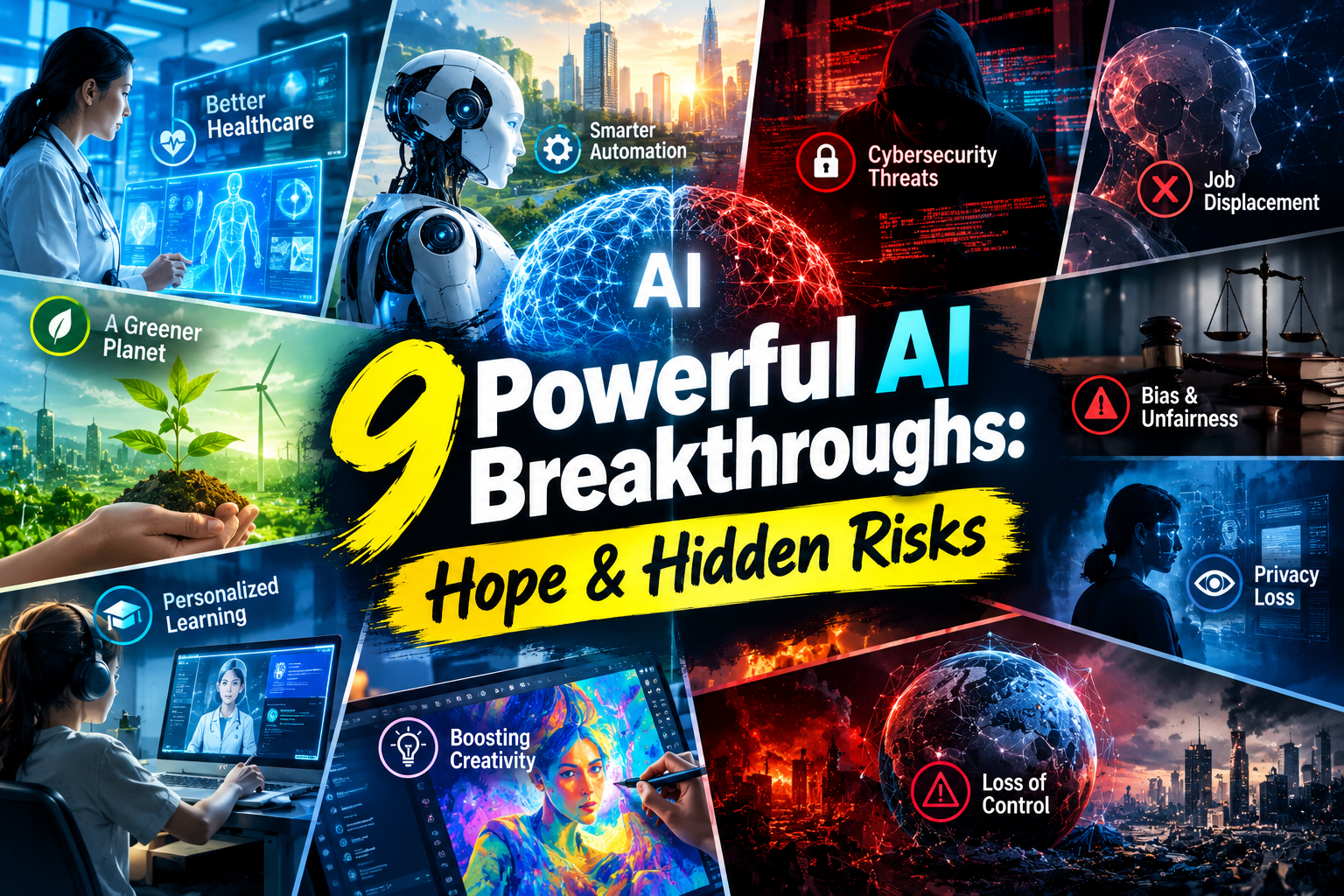
Artificial intelligence is changing the way people work, learn, communicate, and solve complex problems. The latest AI Breakthroughs are creating new opportunities in medicine, scientific research, climate forecasting, robotics, and education. These developments offer hope for a smarter future, but they also raise important questions about privacy, safety, job security, and human control. Understanding these AI Breakthroughs can help readers discover how emerging technologies may improve everyday life while recognizing the risks that require careful attention 9 Powerful AI Breakthroughs: Hope & Hidden Risks.
Table of Contents
- Introduction to AI Breakthroughs
- AI Breakthroughs in Medical Research
- AI Breakthroughs in Scientific Discovery
- AI Breakthroughs in Climate Prediction
- AI Breakthroughs in Personalized Education
- AI Breakthroughs in Robotics and Automation
- AI Breakthroughs in Drug Discovery
- AI Breakthroughs in Language and Communication
- AI Breakthroughs in Cybersecurity
- AI Breakthroughs: Hope, Risks, and the Future
- Conclusion
1. Introduction to AI Breakthroughs
Artificial intelligence has moved beyond simple digital assistants and basic automation. Modern AI systems can analyze enormous datasets, recognize patterns, generate content, and assist experts with complicated tasks. These abilities are making AI useful in fields where traditional methods may take significant time and resources 9 Powerful AI Breakthroughs: Hope & Hidden Risk.
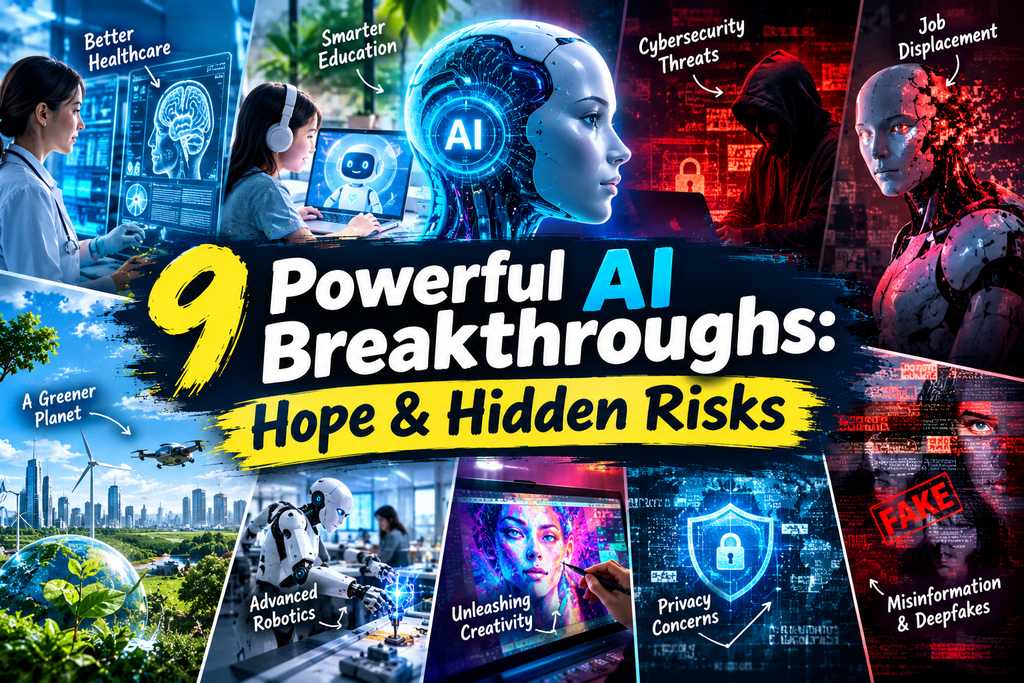
However, not every new AI development is a complete scientific breakthrough. Some technologies represent gradual improvements, while others introduce genuinely new capabilities. The most valuable AI Breakthroughs are those that solve real problems, produce measurable results, and provide benefits that people can access safely.
Researchers are now exploring how AI can support scientific discoveries, improve public services, and make technology more accessible. At the same time, responsible development is becoming increasingly important because inaccurate outputs, biased decisions, and misuse can create serious consequences9 Powerful AI Breakthroughs: Hope & Hidden Risks.
2. AI Breakthroughs in Medical Research
Healthcare is one of the most promising areas for AI innovation. AI systems can examine medical images, organize patient information, and identify patterns that may be difficult to detect through conventional analysis alone. These capabilities can help qualified medical professionals investigate diseases and make more informed decisions 9 Powerful AI Breakthroughs: Hope & Hidden Risks.
For example, AI-assisted image analysis can help researchers study signs of certain cancers and eye diseases. Instead of replacing doctors, these systems can provide additional information for trained professionals to review. Their usefulness depends on the quality of the training data, the clinical setting, and independent testing.
AI Breakthroughs in Early Disease Detection
Early detection can make a major difference in managing many medical conditions. AI tools can analyze scans and other clinical data to flag suspicious patterns that deserve further examination. In research environments, machine learning can also help identify possible relationships between symptoms, risk factors, and disease progression.
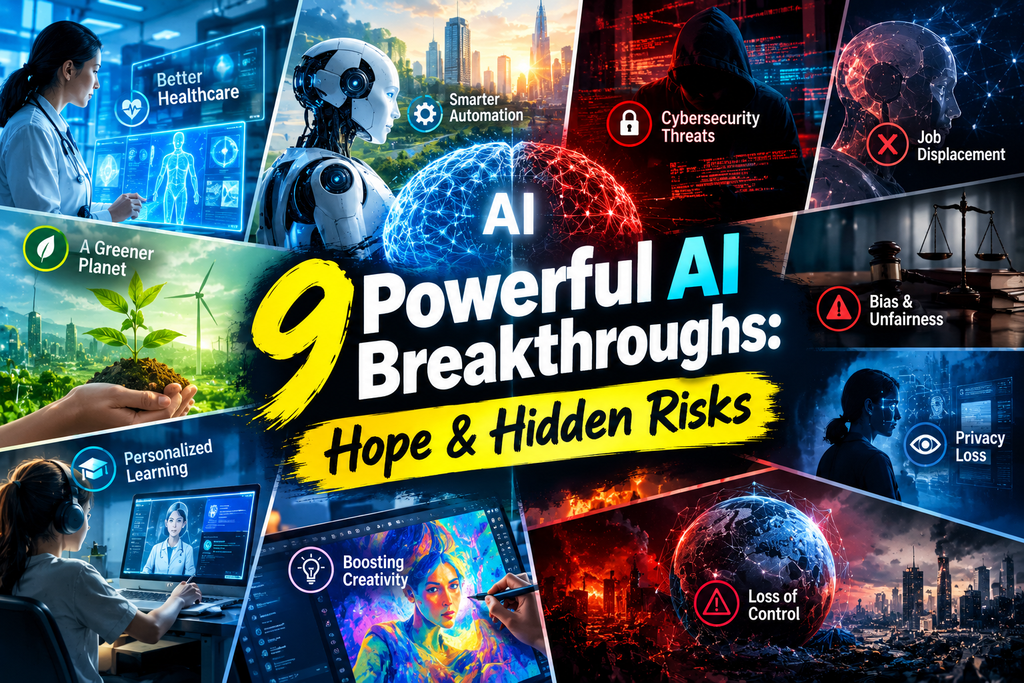
Nevertheless, an AI prediction is not the same as a confirmed diagnosis. Systems can miss important signs or produce false alarms. Medical AI therefore requires clinical validation, privacy protection, and appropriate human oversight before it is trusted in patient care 9 Powerful AI Breakthroughs: Hope & Hidden Risks.
3. AI Breakthroughs in Scientific Discovery
Scientific research often involves analyzing millions of observations, testing hypotheses, and repeating experiments. AI can help researchers process complex datasets and identify promising directions for further investigation.
One important example is protein structure prediction. AI systems have helped scientists predict many protein structures, providing useful information for biological research. Such predictions can support investigations into how proteins function and how they interact with other molecules 9 Powerful AI Breakthroughs: Hope & Hidden Risks.
AI Breakthroughs in Faster Research
AI tools can also help analyze astronomical observations, identify materials with desirable properties, and examine large scientific databases. Instead of manually reviewing every possibility, researchers can use computational models to narrow down the options that deserve experimental testing.
Still, a computer-generated prediction does not automatically prove a scientific theory. Laboratory experiments, reproducible evidence, and expert review remain essential. The strongest AI Breakthroughs combine computational speed with careful scientific verification 9 Powerful AI Breakthroughs: Hope & Hidden Risks.
4. AI Breakthroughs in Climate Prediction
Climate change creates challenges for communities, governments, farmers, and emergency services. AI can help analyze weather observations, satellite images, and historical climate information to improve certain forecasting tasks.
Machine learning models can identify patterns in atmospheric data and help produce forecasts more efficiently. These tools may support flood preparedness, wildfire monitoring, agricultural planning, and early-warning systems for extreme weather 9 Powerful AI Breakthroughs: Hope & Hidden Risks.
AI Breakthroughs for Climate Risk Reduction
AI-assisted forecasting can help decision-makers understand where risks may be increasing. Farmers may use improved weather information to plan irrigation, while emergency teams can combine forecasts with local information to prepare for dangerous conditions.
However, AI does not eliminate uncertainty in weather and climate science. Forecast quality depends on reliable data, regional conditions, and the model being used. Climate models must also account for long-term physical processes that cannot be understood through pattern recognition alone 9 Powerful AI Breakthroughs: Hope & Hidden Risks.
Another challenge is energy consumption. Training and operating large AI systems can require substantial electricity and water for cooling. Sustainable AI development should therefore consider both the environmental benefits of applications and the resources required to run them.
5. AI Breakthroughs in Personalized Education
Education is another field where AI can provide practical support. Intelligent learning platforms can adjust practice questions, explain concepts in different ways, and help students identify areas where they need more preparation 9 Powerful AI Breakthroughs: Hope & Hidden Risks.
For instance, a student struggling with statistics may benefit from additional worked examples, while another student may prefer visual explanations. AI tutoring tools can provide immediate feedback and help learners study at their own pace.
AI Breakthroughs for More Accessible Learning
AI can also support translation, speech-to-text services, reading assistance, and educational content for learners with different needs. These features may help make information easier to access across languages and learning environments 9 Powerful AI Breakthroughs: Hope & Hidden Risks.
Yet AI-generated explanations can contain errors. Students may also become too dependent on automated answers instead of developing independent thinking skills. Teachers and educational institutions should use AI as a supporting resource rather than a complete replacement for human guidance 9 Powerful AI Breakthroughs: Hope & Hidden Risks.
Protecting students’ personal information is equally important. Educational platforms should explain how data is collected and avoid unnecessary tracking.
6. AI Breakthroughs in Robotics and Automation
Robotics combines artificial intelligence with machines that can sense their surroundings and perform physical tasks. Recent developments in computer vision, planning, and machine learning are helping robots work in more complex environments.
Robots are already used in manufacturing, warehouses, agriculture, and some healthcare settings. AI can help them recognize objects, plan movements, and respond to changes in their surroundings 9 Powerful AI Breakthroughs: Hope & Hidden Risks.
AI Breakthroughs in Real-World Automation
In agriculture, intelligent machines may help identify weeds or monitor crops. In warehouses, robotic systems can support inventory movement and sorting. In dangerous environments, remotely operated or autonomous machines may reduce the need to expose workers to certain hazards.
Despite these advantages, robots can make mistakes when lighting, obstacles, or surroundings differ from their training conditions. Physical automation also creates concerns about employment transitions and workplace safety 9 Powerful AI Breakthroughs: Hope & Hidden Risks.
Successful adoption requires reliable testing, clear safety procedures, worker training, and realistic expectations about what a machine can accomplish.
7. AI Breakthroughs in Drug Discovery
Developing a new medicine is often expensive and time-consuming. Researchers must investigate potential compounds, evaluate biological effects, and conduct extensive testing to determine whether a treatment is safe and effective 9 Powerful AI Breakthroughs: Hope & Hidden Risks.
AI can help analyze chemical structures, predict molecular properties, and identify compounds that may deserve further study. This can make some early stages of drug discovery more efficient by helping researchers prioritize promising candidates.
AI Breakthroughs in Finding New Treatments
Machine learning models may also help scientists explore existing medicines for new potential uses. By analyzing biological and clinical datasets, researchers can identify connections that might otherwise take longer to investigate.
However, an AI-generated drug candidate is not automatically a successful medicine. Laboratory studies, clinical trials, safety assessments, and regulatory review are still necessary. AI can support the search for treatments, but it cannot remove the need for evidence that a medicine works safely in people 9 Powerful AI Breakthroughs: Hope & Hidden Risks.
8. AI Breakthroughs in Language and Communication
AI language models can generate text, summarize documents, translate languages, and answer questions. These capabilities are changing how people access information and communicate with digital services.
Translation tools can help people understand content in languages they do not speak fluently. Speech recognition can convert spoken words into text, while text-to-speech systems can make written information more accessible 9 Powerful AI Breakthroughs: Hope & Hidden Risks.
AI Breakthroughs and the Risk of Misinformation
The same technology can produce convincing but incorrect information. AI-generated content may also be used to create misleading images, fake audio, or deceptive messages. This makes it important to verify sensitive claims and check original sources.
Businesses, schools, and individuals should be especially careful when using AI-generated information for medical, legal, financial, or other high-impact decisions. Human review and clear disclosure can help build trust 9 Powerful AI Breakthroughs: Hope & Hidden Risks.
9. AI Breakthroughs in Cybersecurity
As more services move online, cyberattacks and digital fraud remain serious concerns. AI can help security teams examine network activity, detect unusual patterns, and prioritize alerts that may indicate a threat.
For example, an AI system may identify suspicious login behavior or recognize activity that differs from a user’s normal pattern. These capabilities can help analysts investigate possible attacks more quickly 9 Powerful AI Breakthroughs: Hope & Hidden Risks.
AI Breakthroughs Against Digital Threats
AI-assisted security tools can support fraud detection, spam filtering, and the analysis of malicious software. They may also help organizations process large volumes of security information that would be difficult to review manually.
However, attackers can use AI too. Automated phishing messages, impersonation attempts, and other forms of digital abuse can become more convincing. Security systems may also generate false alarms or miss unfamiliar attacks.
Effective cybersecurity therefore requires multiple layers of protection, regular updates, secure authentication, trained staff, and human oversight. AI is one part of a wider defense strategy, not a guarantee of complete safety 9 Powerful AI Breakthroughs: Hope & Hidden Risks.
10. AI Breakthroughs: Hope, Risks, and the Future
The future of artificial intelligence will depend on how well society balances innovation with responsibility. AI may help researchers develop better tools, support scientific discovery, improve accessibility, and make some services more efficient 9 Powerful AI Breakthroughs: Hope & Hidden Risks.
At the same time, several risks deserve serious attention. Biased training data can produce unfair outcomes. Poorly protected systems can expose sensitive information. Automated decisions may be difficult to explain, and some jobs may change as organizations adopt new technology.
AI Breakthroughs and Responsible Innovation
Responsible AI development involves testing systems before deployment, protecting personal data, monitoring performance, and providing ways for people to challenge important decisions. Researchers should also evaluate how systems behave in unfamiliar situations and communicate their limitations honestly.
Governments, businesses, universities, and technology developers all have roles to play. Clear standards and public understanding can help ensure that useful innovations do not come at the expense of safety or fairness.
The most meaningful progress will not simply involve creating more powerful AI. It will involve building systems that are reliable, transparent, useful, and aligned with human needs.
11. Conclusion: AI Breakthroughs for a Better Future
AI Breakthroughs are creating new possibilities in medicine, scientific research, climate forecasting, education, robotics, drug discovery, communication, and cybersecurity. These technologies can help people analyze information faster and explore solutions to complex problems.
Nevertheless, their benefits are not automatic. AI systems can make mistakes, reflect bias, consume resources, and be misused. Careful testing, human judgment, privacy protection, and responsible governance remain essential.
The future of AI will be shaped by the decisions people make today. By supporting evidence-based research and addressing risks early, society can encourage AI Breakthroughs that deliver meaningful benefits while protecting people and communities.